

To begin, a short calculation. What is the expected value of a EUR 100 cash flow with an 80% probability of occurring? EUR 80, of course. And the expected value of a EUR 1,000 cash flow with an 8% probability? Also EUR 80. Straightforward enough for a business valuer.
Anyone assessing business value works with expected values and distributions. How likely are particular events? How are the associated cash flows distributed? How wide is the range of possible outcomes? These questions must be understood to calibrate a discounted cash flow model properly, determining both the expected cash flows in the numerator and the risk-appropriate discount rate in the denominator.
Unfortunately, financial reporting offers only limited help. Expected-value thinking is underrepresented, which might be tolerable because expected values require management judgements that external analysts may not want as their starting point. More fundamentally, the balance sheet mixes very different measurement concepts. It lacks a consistent approach, and valuers must understand this when translating accounting figures into their own expected-value framework.
A recent example illustrates the problem. Less than a month ago, California-based Pacific Gas & Electric (PG&E), the largest US utility, had to seek bankruptcy protection because potentially successful claims for billions of dollars relating to recent California wildfires threatened to overwhelm it financially. Ageing overhead power lines may have helped start the fires. This was dramatic for shareholders, but arguably even more troubling for financial reporting. The full scale of the risk had been known for some time, yet it was absent from the balance sheet.
By its 2017 annual report at the latest, PG&E had explained under Note 13, ‘Contingencies and Commitments’, with reference to earlier wildfires, that its liability could substantially exceed the approximately USD 10 billion estimated for the October 2017 fires. It also stated that it could not reasonably estimate the amount or range of potential losses. Ultimately, PG&E concluded that the probability of being held liable was too low for recognition under US GAAP. The matter was therefore disclosed only in the notes.
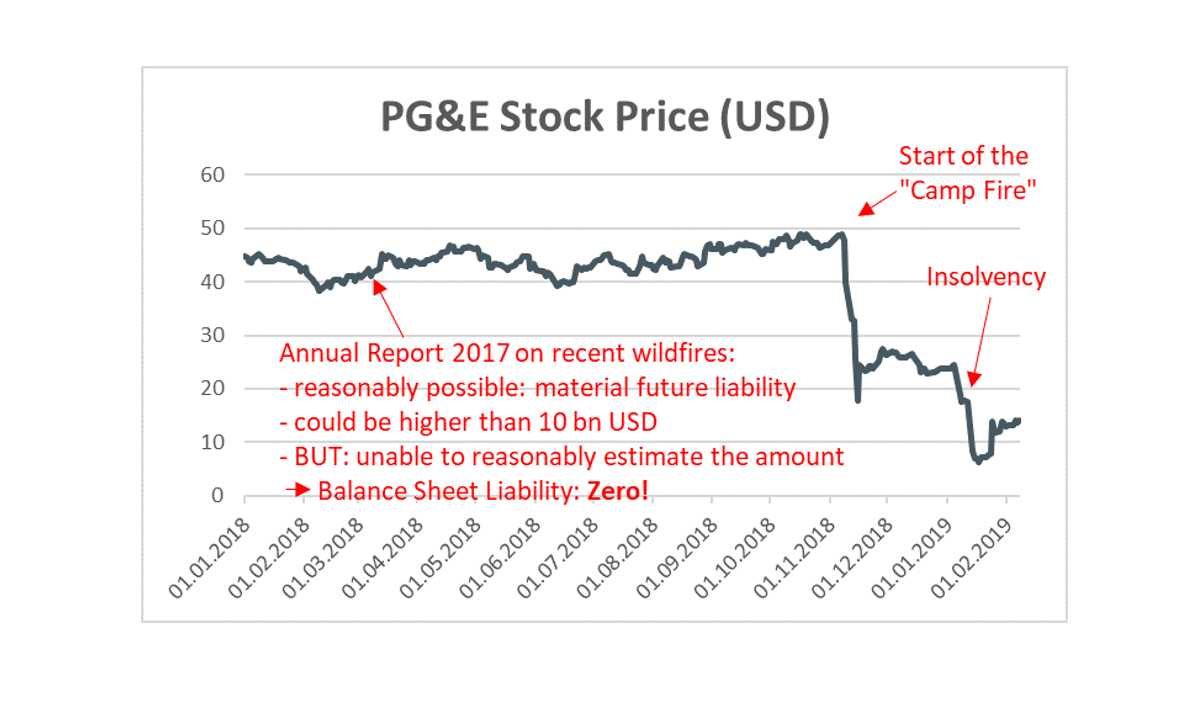 The rest is history. When fires again swept through PG&E’s service area in November 2018, in the event known as the Camp Fire, pressure intensified dramatically. The risk of successful claims, now receiving extensive public attention, seemed to rise inexorably. On 14 January 2019, the company announced that it would soon file for bankruptcy protection.
On the information currently available, PG&E’s accounting treatment was correct. Under US GAAP, a liability is recognised when a claim is ‘likely to occur’, commonly interpreted as a probability of approximately 80%. Under IFRS, the threshold is ‘more likely than not’, approximately 50%. The intention is to recognise events that can reasonably be expected, rather than every conceivable possibility. At the 2017 reporting date, the risk of successful claims apparently did not clear the applicable threshold.
For business valuation, however, such probability thresholds are secondary. What matters is the expected value. As the opening calculation shows, a very large amount multiplied by a small probability, and therefore NOT recognised as a liability, can equal or exceed a small amount multiplied by a high probability, which IS recognised. Investors automatically pay less attention to items absent from the balance sheet than to recognised liabilities. That appears to have happened at PG&E.
Anyone who read the notes carefully could probably have concluded, without special foresight and at least by the publication of the 2017 annual report in February 2018, that further fires in California were likely, regardless of their cause, that PG&E’s equipment would not be modernised quickly, and that suspicion would consequently fall on PG&E again while its defence remained weak. A material worsening of a problem already measured in the region of USD 10 billion was therefore foreseeable.
Equity markets nevertheless responded fairly calmly to the disclosures. They did not ignore the issue entirely, but seemed reluctant to acknowledge its full scale. PG&E’s share price shows that the market did not fully absorb the implications until wildfires broke out again in November 2018.
PG&E is a particularly severe example of the On/Twilight/Off financial analysis problem: ‘On’ means recognition on an assumed 100% basis, ‘Twilight’ lies somewhere between 0% and 100%, and ‘Off’ means exclusion from the balance sheet, as in this case. The underlying issue runs throughout both IFRS and US GAAP.
A partial review of IFRS assets reveals a largely binary On/Off approach that is difficult to justify economically. Assets are either recognised in full or not recognised at all. This is unproblematic for many physical assets, such as machinery or inventories, but problematic for many intangibles. Research and development expenditure is the classic example. Basic research is not recognised as an asset because its eventual conversion into cash flows is considered too uncertain. Development expenditure, once a degree of product maturity has been reached, can be recognised in full. Neither extreme adequately captures valuation reality. Development usually has a higher probability of generating cash flows than basic research, but in both cases the probabilities are often far from either zero or 100%.
Recognition of tax loss carryforwards also requires a probability of utilisation above 50%. Above that threshold, they can be recognised in full. Below it, nothing is recognised. Again, economic reality lies between the extremes. At their peak, unrecognised tax loss carryforwards attributable to the French utility Veolia Environnement S.A. amounted to almost EUR 1 billion. They were absent from the balance sheet but had substantial value for business valuation, as subsequent developments also demonstrated.
The IFRS liabilities side is more varied. Financial liabilities are initially recognised at a value reflecting expectations at issuance, including default risk. Subsequent changes in expectations, particularly changes in default risk, are usually not reflected. An exception applies where liabilities are carried at fair value, most commonly by banks and other financial institutions. In those cases, the counterintuitive but economically correct effect can be observed: the expected liability falls as the company moves into financial distress. A later article will examine this in detail.
Provisions are also intended to reflect expected values, using current expectations. Since they relate to future events, the time value of money matters, but it is often omitted, distorting the resulting values. Long-term provisions are discounted, although on a different basis from financial liabilities. Standard setters prescribe discount rates that, in the cases discussed here, refer to high-quality corporate bond yields rather than the company’s actual default risk. This can move reported amounts further away from the relevant expected value.
At least the unsatisfactory treatment of lease obligations has finally changed with effect from 1 January 2019. Until recently, contractual structuring could determine whether a lease liability and the related asset appeared ‘On’ the balance sheet as a finance lease or remained ‘Off’ as an operating lease. Companies keen to report low financial debt and stronger creditworthiness generally preferred operating leases. The new requirement to bring leases onto the balance sheet is a sensible development.
Many more examples could be given. To avoid misunderstanding, however, recognition limits are often reasonable. Standard setters want to restrict subjectivity, so a perfect accounting system is unlikely to exist in practice. We must accept that, but two major qualifications remain.
First, valuers need to know precisely which probability concept, On, Twilight or Off, is embedded in each item so that they can reflect it appropriately in their own forecasts. That concept is often far from obvious.
Second, recent IFRS developments have something of a patchwork quality. The underlying measurement principles are becoming no clearer. I therefore understand why some observers are rediscovering an appreciation for traditional German HGB accounting. Much of it was far removed from forward-looking values and appropriate probabilities, but its approach was considerably more consistent.
The analyst must therefore read the notes, adjust the probabilities underlying recognised and unrecognised items for analytical purposes and, if necessary, construct a separate economic balance sheet using valuation-relevant criteria rather than IFRS. Business valuation permits this flexibility because it is not constrained by mandatory accounting rules.
While these On/Twilight/Off issues are still being debated, darker clouds are gathering on the accounting horizon. Academics Baruch Lev and Feng Gu have proclaimed ‘The End of Accounting’. A future article will discuss what they mean, much of which relates to the issues covered here, with particular emphasis on ‘Off’, and whether the situation is really that serious.