

In a few days, Germany’s two major utilities with nuclear exposure, RWE AG and E.ON SE, will present their 2018 annual results. Provisions for dismantling nuclear power plants will again be a topic of discussion. The most intense phase of the German debate on nuclear provisions is now over. In mid-2017, the two utilities reached a funding solution for interim and final waste storage that was sensible for all parties. The remaining decommissioning provisions no longer threaten their financial survival. Nevertheless, the reported obligations remain material: EUR 6 billion for RWE and EUR 10.5 billion for E.ON at the end of 2017.
The accounting treatment shows that the future cash outflows associated with decommissioning were estimated and discounted at a risk-free rate. RWE stated that the discount rate, based on prevailing market rates for risk-free investments, was 0.6% at the reporting date (Annual Report 2017, p. 131). E.ON likewise reported an average risk-free discount rate of approximately 0.6% (Annual Report 2017, p. 179). The technical detail that the final calculations used real cash flows and real interest rates does not affect the argument here. For explanatory purposes, we can continue using nominal figures, including inflation adjustments.
Comparing this treatment with that of financial liabilities such as loans or bonds reveals a difference. Decommissioning provisions are apparently recognised on the assumption that the utilities will certainly fulfil them, as indicated by risk-free discounting. Financial liabilities, by contrast, are recognised on the assumption that payment is uncertain. Their initial carrying value generally reflects the value established by investors, whether in capital markets or by banks, which already incorporates default risk. All else being equal, the lower discount rate therefore produces a substantially higher value for the provisions than the higher rate used for financial liabilities.
One might object that default risk should not be reflected in nuclear provisions at all. Why should utilities be allowed to improve their reported position merely because they have a particular credit risk profile, with both currently rated BBB for long-term debt? Surely they should fulfil their obligations to society. Such considerations may well have influenced standard setters’ approach to decommissioning provisions. A similar issue arises with pension obligations, discussed below.
The economic perspective is different, however. From the perspective of shareholders in a limited liability company, obligations need only be met while the company has the financial capacity to do so. If it becomes insolvent, shareholders are not required to contribute additional funds. Their downside is limited to an equity value of zero. This limitation applies to bonds and loans just as it does to decommissioning obligations. Anyone interested in the fair value of the business must therefore value long-term provisions on the same economic basis as bonds.
Before revaluing decommissioning provisions, two questions need to be addressed:
- Where do decommissioning obligations rank in the order of payment? There is currently no definitive answer, but it is reasonable to assume that their position is broadly comparable to the companies’ long-term debt.
- Is all the information required for revaluation available? Not entirely, but there is enough for a practical approximation. Assuming that the provisions rank similarly to the utilities’ long-term bonds, and therefore have approximately the same risk- and duration-adjusted discount rates, the interest-rate sensitivity disclosures in the notes can be used to adjust their values. For simplicity, we disregard present-value convexity, which becomes particularly relevant for larger changes in discount rates.
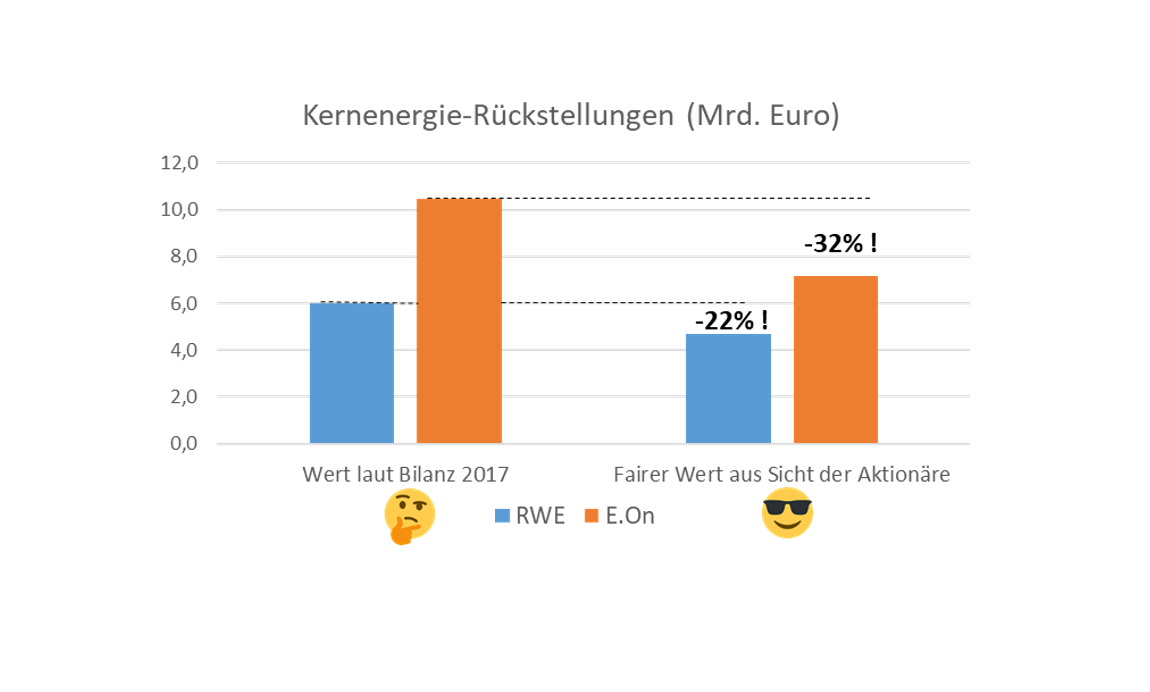
A valuation from the shareholders’ perspective then gives the following picture:
Original figure, explained in English
Nuclear provisions, in EUR billions. The first pair of bars shows 2017 carrying amounts and the second pair fair values from the shareholders’ perspective. Blue represents RWE and orange represents E.ON. The annotations show reductions of 22% for RWE and 32% for E.ON.
The differences between reported carrying amounts and fair values from the shareholders’ perspective are clearly material. Note that the revaluation changes only the discount rate. The estimated project cash flows remain unchanged.
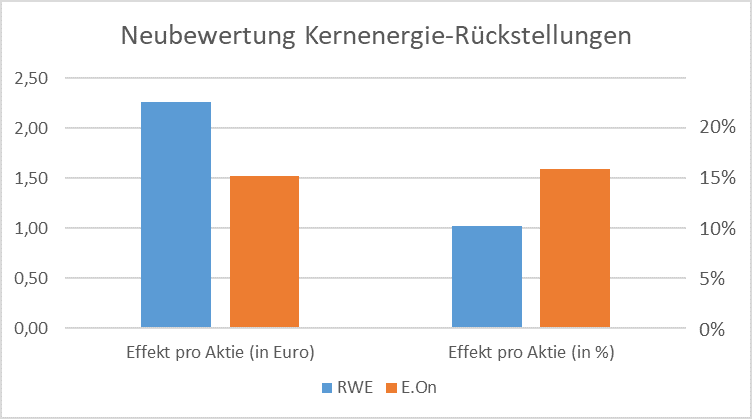
Original figure, explained in English
Revaluation of nuclear provisions. The first pair of bars shows the effect per share in euros, using the left-hand scale. The second pair shows the effect per share as a percentage, using the right-hand scale. Blue represents RWE and orange represents E.ON.
Pension provisions receive very similar accounting treatment. They are also discounted at rates that, for most companies, are much too low from a business valuation perspective: yields on high-quality corporate bonds, approximately those rated AA. From the shareholders’ perspective, this generally produces a substantial overstatement of the liability. One probable reason is public reluctance to have the accounts imply that a company might not fulfil its employees’ pension entitlements with certainty.
For the business valuer, however, that consideration is not decisive. Given the continuing size of pension provisions, particularly in Germany, an appropriate adjustment is essential when valuing a company from its shareholders’ perspective.
Markets frequently overlook this accounting misvaluation of long-term provisions, whether nuclear or pension-related, for two reasons:
- These provisions are not traded. Unlike bonds, they have no market. Unlike bonds and loans, they also lack a direct counterparty with a regular interest in valuing the particular obligation.
- Compounding this, there are generally no transactions involving these items. The obligations are settled through payment or performance. Exceptions, such as the state assuming part of the nuclear obligations or insurers taking over pension obligations, are usually driven by considerations beyond valuation alone.
The conclusion is that insolvency risk does not have exclusively negative effects from shareholders’ perspective. The floor of zero on equity value, and the corresponding protection from having to contribute additional funds, provides an offsetting benefit in certain areas, including the individual liabilities discussed here. A forthcoming article will examine this positive component of higher insolvency risk in more detail.