

Financial statement analysis is an essential skill for anyone working seriously with business valuation. Whether the assignment concerns investment decisions, fairness opinions or expert valuation reports, a thorough understanding of the company’s accounts is fundamental. Today, however, reading the numbers alone is not enough. Analysts must also examine what lies behind them. In this occasional series, we explore some of the challenges of modern financial statement analysis.
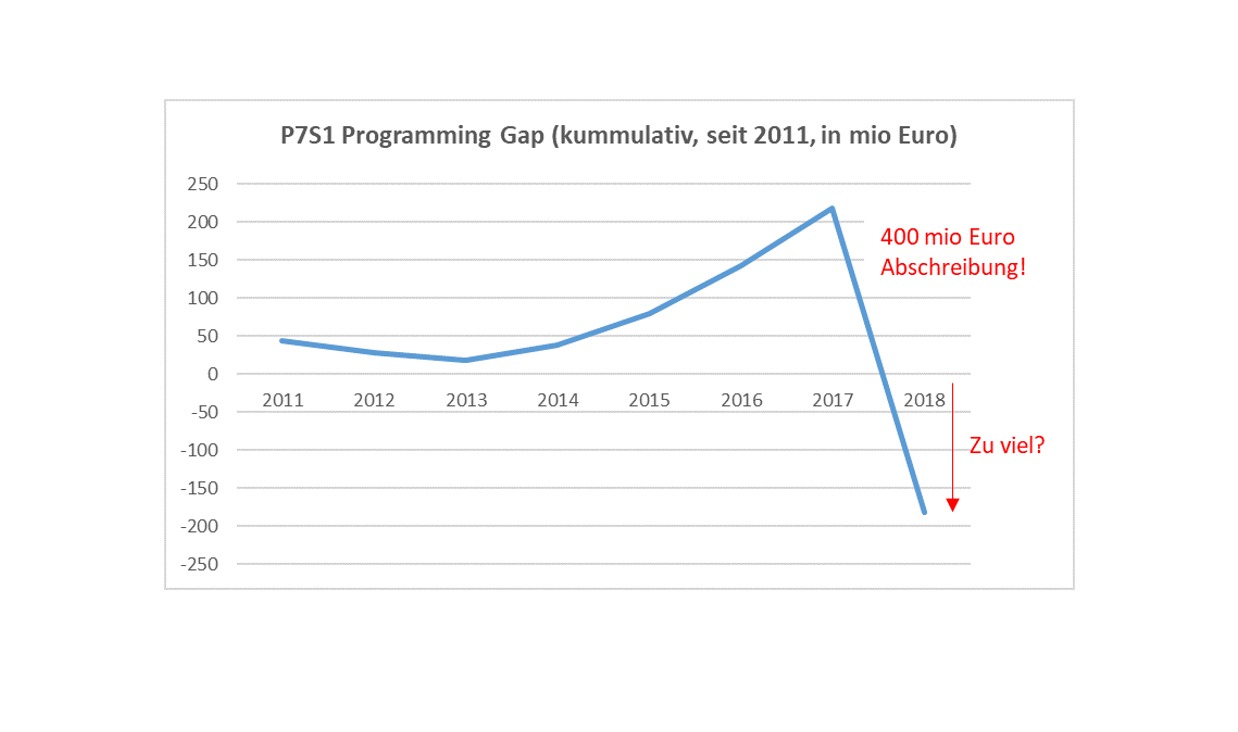
Last week’s article discussed impairments, and accounting write-downs are again our focus. This time, the starting point is an event that had been years in the making. ProSiebenSat.1 Media SE’s ‘programming gap’, relating to an economically significant asset, had become notorious in equity markets. It described the persistently negative difference between amortisation of programme licences and expenditure on those licences. Investment exceeding amortisation would not have been problematic if the related revenue had grown accordingly: that would have represented growth investment. But revenue did not develop in that way. Over the years, more investors concluded that the gap instead reflected insufficient amortisation, or excessively long useful lives, intended to make reported earnings look better. Lower amortisation means higher profits.
As the saying goes, ‘If something cannot go on forever, it will stop.’ Such a gap cannot expand indefinitely, although ProSiebenSat.1 managed it for many years. Expectations of an eventual impairment of programme licences therefore grew. In November 2018, it finally happened. At the company’s Capital Markets Day, CEO Max Conze, who had only taken office in June 2018, announced an impairment of approximately EUR 400 million. His recent appointment is relevant, as discussed below. Just as investors and analysts were preparing to tick off this overdue correction, he added that there would be no more unpleasant surprises. Many found that reassuring, but some raised their eyebrows. How could he know? If the licences had now been written down to fair value and their business outlook deteriorated further the following year, another impairment would be required. Unwelcome, certainly, but that is how impairments work. Why, then, the confidence that there would be no further surprises?
Original figure, explained in English
ProSiebenSat.1 programming gap, cumulative since 2011, in EUR millions. The red annotations identify the EUR 400 million write-down and ask whether it was excessive.
Based on figures from 2011 onwards. The programming gap was already apparent before then, so some developments shown here are estimated.
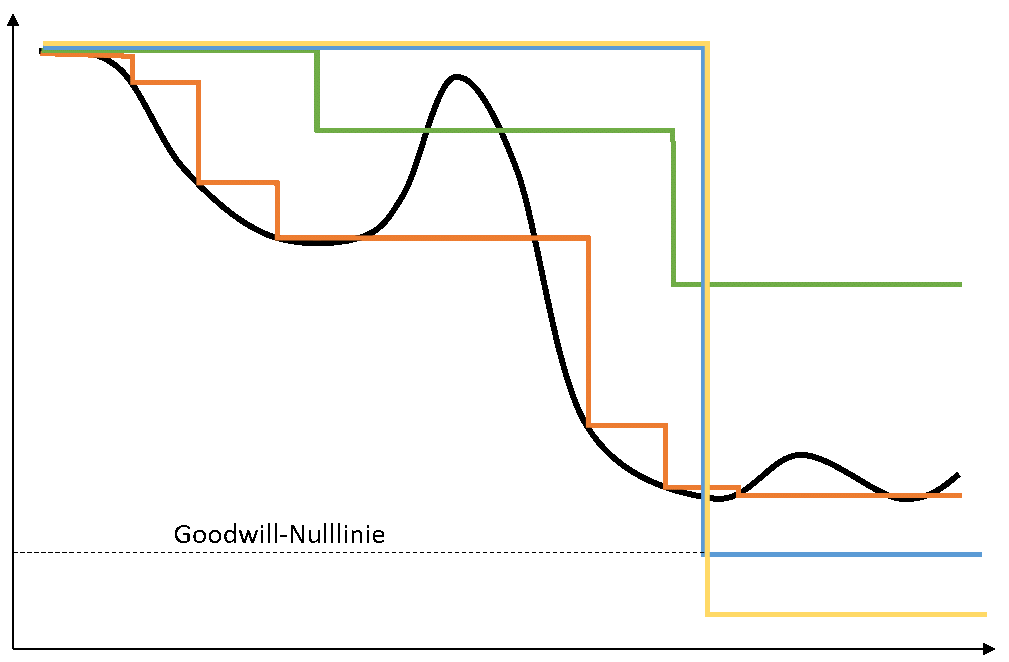
To understand those investors’ concerns, we need to distinguish different forms of impairment testing. Not all impairments are alike. They require numerous estimates of future cash flows and the cost of capital, leaving management considerable discretion. The following chart illustrates several typical cases. The thick black line represents the asset’s actual value as a benchmark. We also assume that management can estimate that value reasonably well. In practice, further analytical adjustments may be necessary.
Original figure, explained in English
The dashed horizontal line marks the point at which goodwill has been fully written off. The black curve shows underlying value. Orange denotes appropriate impairment recognition, green delayed recognition, blue soft kitchen sinking and yellow hard kitchen sinking, as discussed below.
Case 1, orange: appropriate application. This is the economic ideal envisaged by IFRS and US GAAP. Subject to minor technical qualifications that are not relevant here, carrying value is reduced each quarter when market value is lower. Upward adjustments are not made, at least for goodwill. Crucially, impairment reflects the current fair value. Management cannot responsibly promise the market anything about future impairments. If fair value falls again next quarter, another write-down is required.
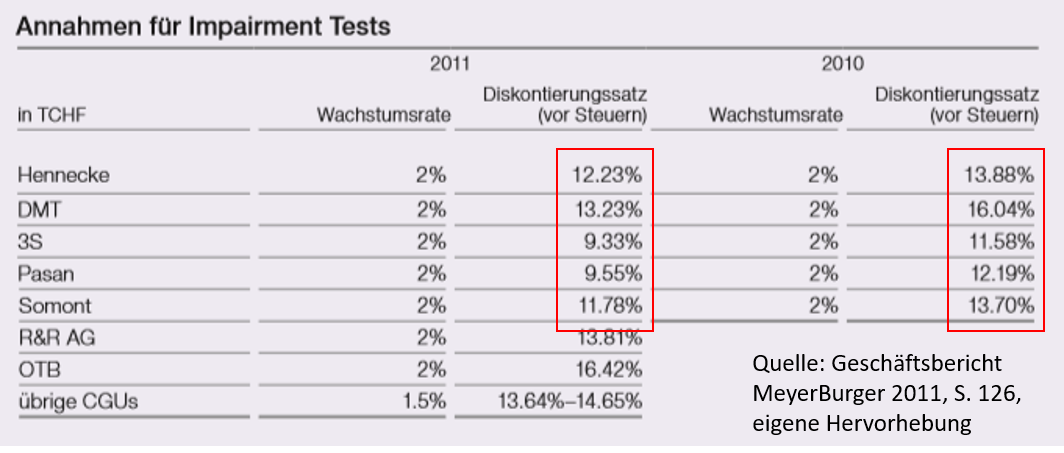
Case 2, green: reluctant application. This is the common real-world case: impairments arrive, but too little and too late. See also Hirschey and Richardson, Financial Analysts Journal, 2003. Management uses its discretion to manage impairments until a threshold is crossed beyond which auditors can no longer be persuaded. Examples are too numerous to list. Without recommending the practice, my experience suggests that the main opportunity to conceal losses lies in the detailed forecast period, the first few years of projected cash flows. Management presents a slightly rosier future than warranted, something outsiders cannot easily challenge. In recent years, discount rates and long-term growth rates have offered less room because auditors have more benchmarks and can identify questionable assumptions more readily. They have not disappeared from the picture, however. In 2011, silicon-wafer saw manufacturer Meyer Burger Technology AG persuaded its auditors to accept lower discount rates for impairment testing during the photovoltaic industry crisis, despite a much riskier business environment. Its share price fell from EUR 23 at the end of 2010 to EUR 12 at the end of 2011.
Original figure, explained in English
Impairment testing assumptions, with columns for growth rate and pre-tax discount rate in 2011 and 2010. TCHF means thousands of Swiss francs. Growth is 2% for the named units and 1.5% for other cash-generating units in 2011.
Pre-tax discount rates for 2011 versus 2010 are: Hennecke 12.23% versus 13.88%, DMT 13.23% versus 16.04%, 3S 9.33% versus 11.58%, Pasan 9.55% versus 12.19%, and Somont 11.78% versus 13.70%. The 2011 rates also include R&R AG at 13.81%, OTB at 16.42% and other cash-generating units at 13.64%–14.65%. Source: Meyer Burger Annual Report 2011, p. 126, with the author’s highlighting.
Case 3, blue: soft kitchen sinking, sometimes called ‘easy life’ kitchen sinking. This is where things become interesting. Kitchen sinking, also known as taking a big bath, means recognising as many charges as possible at once, more than necessary. Why would management, normally keen to report strong performance, do this? If things are already going badly, recognising all or most of the damage now clears the way for future periods. The asset base becomes so low that further impairments are unlikely. When a write-down is enormous, markets may care little whether General Electric records USD 23 billion or, say, USD 18 billion. The example is deliberate. Investors tend to place the whole event in the ‘very bad’ category. Soft kitchen sinking means writing down goodwill or other non-amortising assets, such as brands recognised in a purchase price allocation, beyond the actual decline in value. Management wants to avoid future impairment discussions and enjoy an easier life. Warning signs include comments such as ‘no more unpleasant surprises’, ‘dealing with legacy problems’ or ‘establishing a clean base’. What reassures some investors should make experienced analysts pause.
Case 4, yellow: hard kitchen sinking. Writing down more than goodwill often serves another purpose. Reducing the carrying values of depreciable fixed assets and inventories establishes a new basis for future earnings. Written-down machinery generates less depreciation over its remaining useful life, while lower inventory values produce lower cost of goods sold. Future expenses fall and reported profits exceed what they would have been without the write-down. By the following year, the impairment itself may already have been forgotten. This is a powerful earnings boost. Reassuring management comments of the kind associated with soft kitchen sinking are less common here. An uneasy conscience and the prospect of attractive future profits tend to encourage concealment rather than celebration. Tesco Plc’s 2014 annual results provide a comprehensive example worth examining.
Three variations of hard kitchen sinking are particularly important:
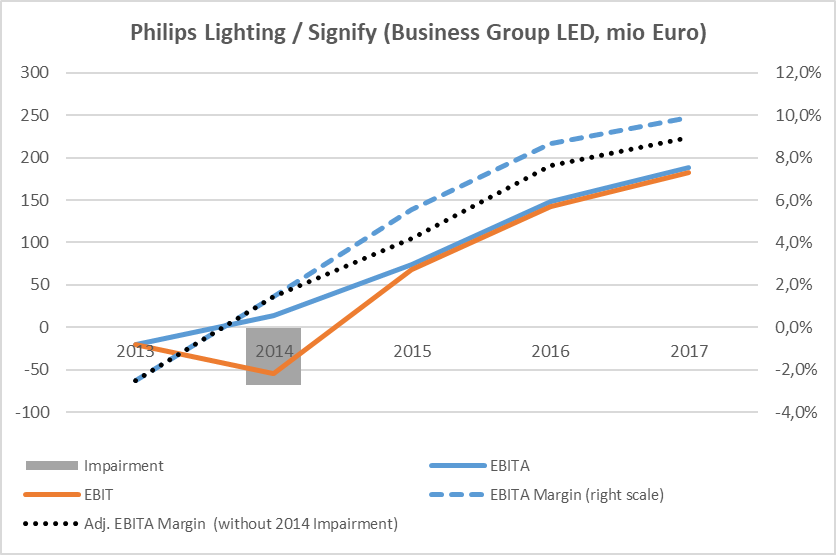
First, impairments of assets other than goodwill in a business unit that attracts little attention. Equity markets may overlook them, but the benefits still flow through to group earnings. In 2014, as an upturn was becoming apparent, Philips Lighting NV, now Signify NV, impaired EUR 68 million of non-goodwill industrial assets in its LED division. Why do so when the recovery was already visible? The write-down reduced the future depreciable base by the same amount, allowing lower depreciation and higher reported profits in subsequent periods. The chart below shows that the LED business group’s reported EBITA margin after the impairment was substantially higher than the margin adjusted for its effects.
Original figure, explained in English
Philips Lighting / Signify, LED business group. Monetary amounts are in EUR millions on the left-hand scale. Margins use the percentage scale on the right. The dotted black line adjusts the EBITA margin to remove the benefit of the 2014 impairment.
Second, the technique need not involve asset write-downs. Provisions can be recognised on the liabilities side. Outdoor advertising company JCDecaux SA, for example, recognised provisions for onerous contracts when acquiring CEMUSA in 2015, then released them gradually over subsequent years. In some periods, releases exceeded 15% of operating profit, providing a substantial earnings boost.
Third, such adjustments are particularly popular in M&A transactions. Changes to asset values or provisions in acquisition accounting generally attract little attention. They increase the residual amount, goodwill, but markets usually accept that. Since goodwill is not amortised, its subsequent treatment can be managed within limits, as described in the green case above. This creates an effective improvement in future reported performance. Carillion Plc. provides another example of creative accounting. In both its acquisition of Alfred McAlpine in 2008 and Eaga in 2011, the British construction group reduced working capital, IT assets and similar items within the purchase price allocation by amounts exceeding 20% of the purchase price in each case.
One might ask whether the reputational damage from large write-downs outweighs any later benefit from higher profits or an easier life. Two points answer that concern:
First, negative news often disappears within a larger event, or its full impact is diluted by the concentration of bad news. Over time, markets typically pay more attention to the subsequent ‘positive’ effects than to the original one-off negative effect.
Second, this is about management’s interests, not investors’ interests. Kitchen sinking is especially common, though not exclusive, around management changes. A new team has little hesitation, and considerable personal incentive, in blaming predecessors: ‘We arrived expecting nothing untoward, discovered what was wrong and corrected it quickly. Now things will improve under us.’ A recent example is Thyssenkrupp CEO Guido Kerkhoff. Only weeks into the role, he recognised, among other items, provisions for quality issues in November 2018, as reported in the company’s press release of 21 November. Deliberately or otherwise, this created additional room for future ‘improvements’. New management may therefore enhance its reputation through kitchen sinking by appearing to clear up inherited problems.
Readers can judge how ProSiebenSat.1’s programming impairment fits this discussion. One point must not be forgotten: every example discussed here may also have sound economic reasons for writing off all goodwill or even more. Each requires individual analysis. This article identifies indicators that analysts and valuers should investigate. Closer examination may reveal a very different picture. It contains no investment recommendations.