

 Financial statement analysis is an essential skill for anyone working seriously with business valuation. Whether the assignment concerns investment decisions, fairness opinions or expert valuation reports, a thorough understanding of the company’s accounts is fundamental. Today, however, reading the numbers alone is not enough. Analysts must also examine what lies behind them. In this occasional series, we explore some of the challenges of modern financial statement analysis.
Original figure, explained in English
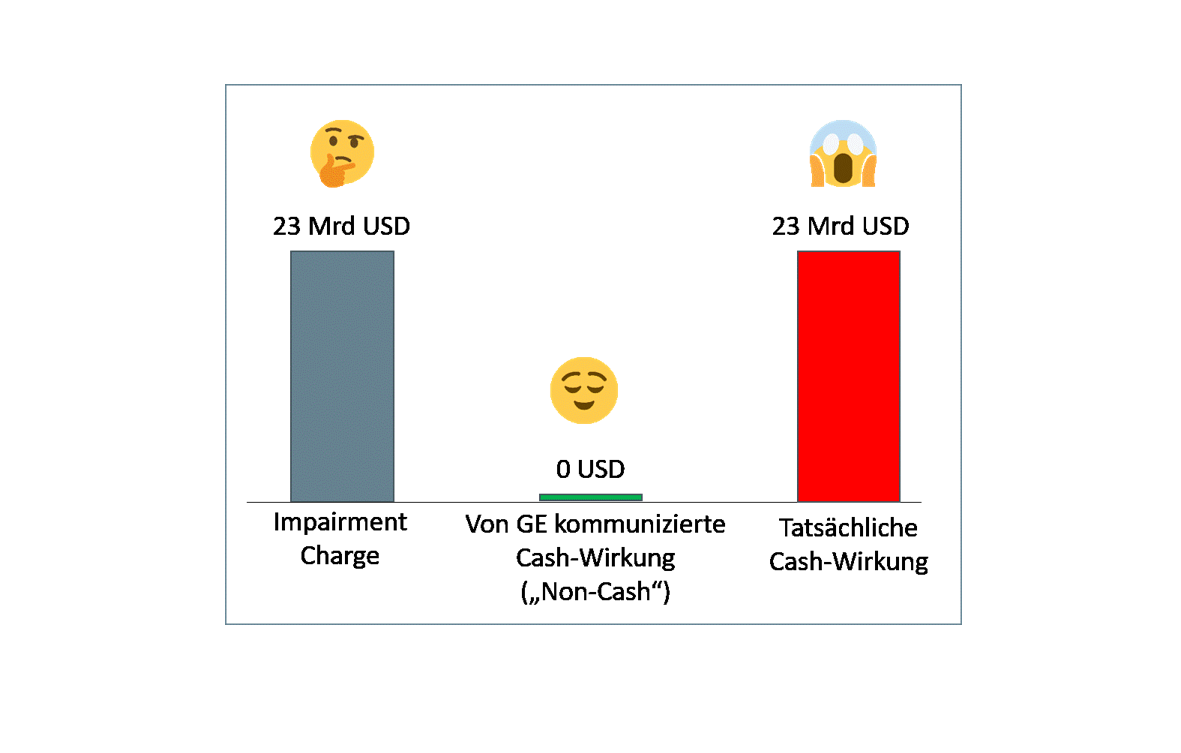
The three bars show the USD 23 billion impairment charge, the zero immediate cash effect emphasised by GE, and the USD 23 billion economic effect of the revised cash flow expectations. The distinction concerns timing and economic meaning, rather than a cash payment of USD 23 billion on the impairment date.
2018 was a terrible year for General Electric. The company recorded a USD 23 billion goodwill impairment, largely relating to assets acquired with Alstom’s power business in 2015. Shortly beforehand, CEO John Flannery, appointed only about a year earlier, had been dismissed and replaced by H. Lawrence Culp Jr.
The company nevertheless appeared keen to play down the development. Its press release of 1 October 2018 highlighted the non-cash nature of the impairment in the headline. Reuters and several equity analysts echoed that description. Non-cash: the emphasis seemed to say, ‘Do not worry. It is only accounting. It has nothing to do with our cash flows, and cash is king.’
Such language is hardly new. In 2001, Deutsche Telekom emphasised the non-cash nature of multibillion-euro write-downs on UMTS licences and goodwill. In 2010, Siemens ended its announcement of a EUR 1.4 billion impairment in its Healthcare division by stressing the absence of a cash impact. In 2011, Sony explicitly stated that an approximately EUR 3 billion valuation allowance against deferred tax assets was non-cash and did not affect consolidated operating income or cash flow. In 2018, Swedish automotive supplier Autoliv likewise highlighted ‘non-cash’ in the headline announcing a charge and repeated the term alongside reassuring language throughout the release. Many more examples convey the same message: write-downs are announced, and their lack of an immediate cash effect is emphasised.
These statements have a serious problem. They are roughly equivalent to a pilot announcing that all engines have failed and the aircraft is in free fall, but reassuring everyone that passengers and crew are still in good health.
First, both statements are technically correct. While the aircraft is still falling, injuries may be limited. Likewise, an impairment generally has no significant cash effect in the period in which it is recognised. It often has no tax effect either, because the adjustment appears only in the consolidated accounts.
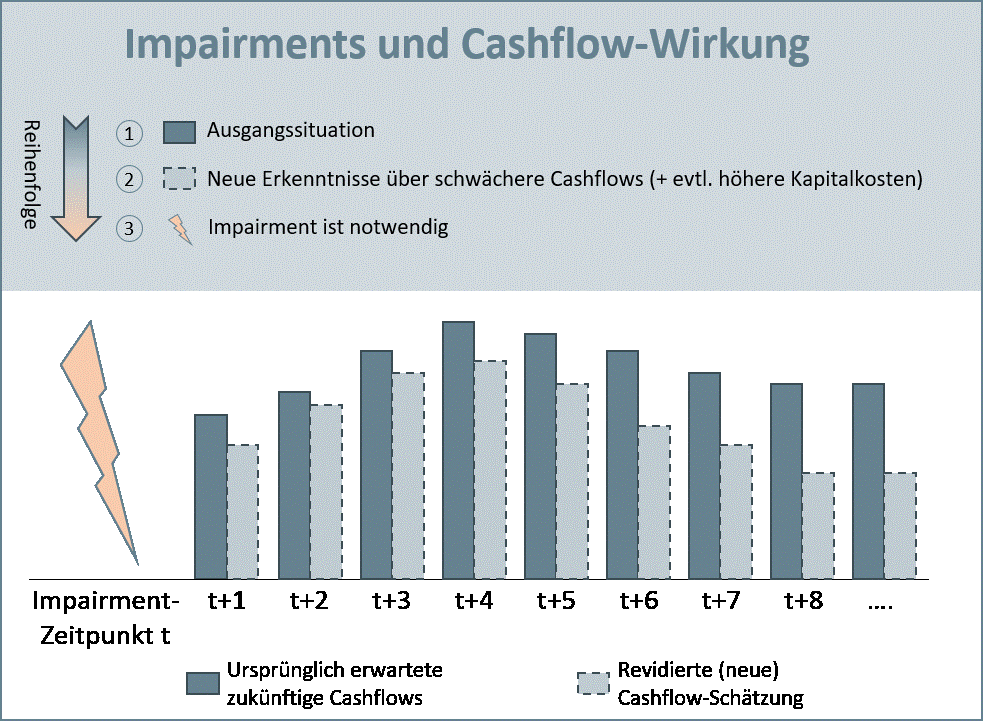
Second, in both cases the situation is highly likely to change dramatically. That is obvious for the aircraft. An impairment occurs precisely BECAUSE the outlook for future cash flows has deteriorated. GE had to write down the Alstom assets because they were expected to generate less cash than originally assumed. The same applied to Siemens, Deutsche Telekom and Autoliv. In 2011, Sony faced the prospect that its subsidiaries’ future performance would be insufficient to turn tax loss carryforwards into cash savings. In every case, substantial downward revisions to expected future cash flows, and therefore substantial future cash effects, triggered the impairment.
Third, both statements miss the point almost cynically. Neither the passengers’ health at that instant nor the immediate cash effect of the write-down is what matters. What counts is what happens next. As Hans Münstermann, a representative of the Cologne school of business valuation, aptly observed in 1966, a buyer pays nothing for the past.
Original figure, explained in English
Impairments and cash flow effects. The sequence is: the original position, new information about weaker cash flows and possibly higher capital costs, and the resulting need for an impairment. At time t, the impairment anticipates lower future cash flows. Solid bars show the original expectations, while dashed bars show the revised estimates for t+1, t+2 and subsequent periods.
It is probably wrong to regard this communication as accidental. Companies frequently emphasise the non-cash nature of negative items but rarely do the same for positive ones. In 2015, for example, French textile group Chargeurs SA recognised tax loss carryforwards following an improved business outlook. The amount was nearly equal to its entire annual net profit. Recognition had no cash effect in that period but implied positive cash effects later. In its investor presentation, the company actively highlighted the resulting improvement in free cash flows.
Valuers must handle these mixed messages carefully because the amounts involved are often substantial. A short analytical guide may help: asset write-downs and depreciation can have three fundamentally different relationships with cash flows.
Non-cash: a wind turbine is purchased and depreciated over its useful life. Viewed as an individual project, the accounting charge occurs AFTER the cash event. Apart from tax effects, depreciation signals no further cash effect. The project eventually ends, and no terminal value is assumed.
Soft cash: business valuations normally assume a going concern. Regular depreciation then lies BETWEEN two cash events. It relates to the original asset purchase but also precedes a future replacement investment. In a company with a balanced asset age profile, from old to new, and therefore relatively stable replacement expenditure, total depreciation is often a useful starting point for estimating future replacement capital expenditure. It indicates future cash outflows. Those outflows, however, are accompanied by future cash inflows from using the new assets. The relationship is therefore one of ‘soft cash’.
Hard cash: impairments generally signal a direct and uncompensated cash effect. The accounting charge occurs BEFORE the adverse cash event. The negative cash consequences are still to come. Unlike replacement expenditure associated with regular depreciation, the company receives nothing in return for the loss in value. The impairment reflects the full adverse effect without an offsetting benefit.
This reasoning assumes that the CFO has applied impairment testing properly: the adjustment reflects the actual change in value and is recognised promptly. The sudden emergence of GE’s impairment gives grounds for doubt. The US Securities and Exchange Commission shares those concerns and is investigating. A forthcoming article will discuss how valuers should respond to such doubts.