


Over the past few days, I have given two presentations on closely related and highly topical subjects: ‘Valuing Digital Business Models’ and ‘The Valuation of Young Tech Companies’. The first was part of a business breakfast organised by Stöhr Faktor Unternehmensberatung (https://stoehr-faktor.de/de/) at Golf Club Hubbelrath in Düsseldorf. The second was at the annual conference
of the Dutch valuation association NiRV in Eindhoven (https://www.nirv.nl/nl/jaarcongres).
Back at my desk, it is time for a brief review.
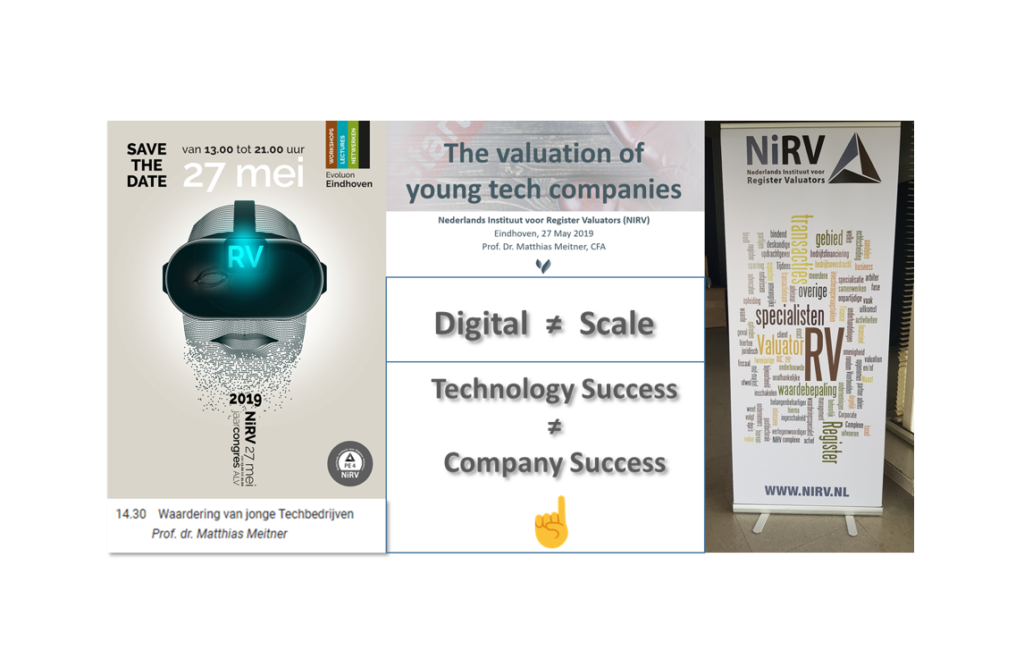
Original figure, explained in English
NiRV Annual Conference, Evoluon, Eindhoven, 27 May 2019, 13:00–21:00. Matthias Meitner’s 14:30 presentation concerns the valuation of young technology companies. The slide emphasises that digital does not automatically mean scalable, and that the success of a technology does not guarantee the success of a company.
Unlike the full-day EACVA seminar on start-up valuation, these presentations allowed me to select a few particular aspects of the subject. Responses to common questions from seminar participants are available here: https://valuesque.com/das-eacva-seminar-start-up-valuation-antworten-auf-push-backs/. I would like to discuss three of the main points below. The first two come with a note of caution, given the sharp rise in valuations in technology start-up funding rounds.
- Digital Does Not Automatically Mean Scalable
We increasingly hear that digital business models are attractive because they scale so well. At best, this is only part of the story. Many start-ups struggle to reach the point at which the full benefits of scale become available. Whether the model involves AI, platforms or pure big data, establishing an initial base can sometimes be easy, a phase we might call ‘loose bootstrapping’. Long before the business becomes self-sustaining, however, accumulating further high-quality data or a critical mass of customers often becomes difficult and expensive: ‘tight bootstrapping’. Even a relatively simple model such as a chatbot rarely progresses beyond answering 50% of enquiries adequately using self-generated data alone. Achieving higher quality requires substantial spending.
The familiar examples, such as Netflix and Uber, have already reached the stage at which scale works in their favour. Typical start-ups still face a difficult journey. Depending on the business model, that journey may be more or less worthwhile and more or less likely to succeed. The more precise the required data, the harder it usually becomes. Some start-ups will certainly make it, and some companies can scale quickly because of first-mover advantages or unique capabilities. From a valuation perspective, however, most models involve far more uncertainty and cost than the optimistic, straightforward scaling scenario suggests. That scenario is rarely the appropriate basis for a valuation.
- A Promising Technology Is Not the Same as a Promising Company
Virtual reality, blockchain, AI, robotics and big data can reasonably be expected to shape our world increasingly over the next few years. A company operating in one of these fields will not automatically develop in step with the technology, however. On the contrary, digitalisation and technological progress are shortening business model life cycles. What is state of the art today will probably look quite different in the near future. Riding a wave and enjoying current success, or more often simply showing promise, does not establish a sustainable competitive advantage. The next technology cycle is approaching, and whether a company remains a leader depends on much more than its presence in a promising field.
Traditional fundamental analysis is therefore particularly important in major technology sectors. Are there barriers to entry? In digital businesses below an attractive level of scale, there often are not. How strong is customer retention? How flexible is the company in an environment likely to change rapidly? These questions determine whether success can be sustained. A useful rule of thumb is that the more attractive the overall technological theme, the more fragile individual business models often are. Valuations that fail to reflect this risk becoming valuations of hype.
- Risk Techniques That Adapt to Uncertainty
Appropriate discount rates or required returns for technology start-ups frequently fall between 30% and 50%. Precise calibration is very difficult. This differs sharply from established businesses, where valuers can draw on experience with typical equity returns and have often developed a reasonable sense of the appropriate rate. For established companies, this makes point estimates, or at least relatively narrow valuation ranges, possible.
One way of handling the substantial uncertainty in technology start-up valuations is to use discount rates within our valuation comfort zone, up to a maximum of 15%, and reflect the remaining risk in the resulting value range. This produces relatively wide ranges, but the probability of capturing the value somewhere within the range can then be similar to the confidence attached to a point estimate in a conventional equity valuation.
Three cautions are necessary. First, a range really is a range. The technology start-up’s value lies somewhere within it with a given probability. Taking the midpoint as a point estimate merely for convenience is not justified. Second, ranges are useful for investment decisions and fairness opinions. A buyer might focus on the lower boundary and a seller on the upper boundary, potentially adding a margin of safety. Benjamin Graham’s traditional margin of safety, incidentally, is 33%. For expert valuation assignments, however, the technique often reaches its limits because a point estimate is required. Third, translating residual uncertainty into a specific range is not straightforward. With practice, however, the technique can be learnt.