

2015 was a reasonably good year for Barclays Plc. The British bank reported a pre-tax profit of GBP 2.1 billion. A closer look, however, revealed that more than GBP 400 million, almost 20%, came from an ‘own credit gain’. This information was difficult to find and received little explanation. The bank’s former CFO, Chris Lucas, who had told the Financial Times in 2011 that the market widely regarded reporting own credit gains and losses as misrepresenting actual business profitability, had already left. He would probably have had a few words of explanation to offer.
What lay behind this positive contribution, which no longer exists in quite the same direct form but remains in a softer form? Under IAS 39, companies that elected the fair value option for their liabilities, subject to criteria beyond the scope of this article, could recognise changes in those liabilities’ fair value in profit or loss. In practice, this was almost entirely confined to financial institutions.
If an outstanding bond falls in value, that benefits the issuing company because its liability becomes smaller, producing a gain in profit or loss. If the bond rises in value, the liability becomes larger and the company records a loss. One particular aspect of this rule troubled Chris Lucas and many analysts and investors. When a company’s business environment deteriorates and overall risk rises, its credit risk often increases as well. Higher credit risk, all else being equal, reduces the fair value of its debt. The company could consequently recognise a gain. In short, it could report a gain because its own credit standing had deteriorated: an own credit gain.
This is hardly intuitive. Standard setters were unconvinced too, and changed the treatment when IFRS 9 replaced IAS 39 in 2018. Own-credit-related changes now flow through other comprehensive income (OCI) into equity rather than through profit or loss. They therefore no longer produce gains and losses in the income statement, but they still increase or reduce equity. Criticism has diminished as a result, although it has certainly not disappeared.
Before joining the criticism, it is worth examining the rule more closely. We first need to consider the basic structure of financial reporting.
Virtually all major accounting systems treat what remains after positive and negative items have been accounted for as equity, or as attributable to equity holders. Technically, equity is a residual. On the balance sheet, it is what remains after liabilities are deducted from assets. In the income statement, the amount left after expenses are deducted from income, net profit, is attributed to equity holders.
This residual structure is mathematically convenient but not necessarily economically meaningful. Thyssenkrupp AG and Casinos Austria AG, for example, recently both reported annual net profits of approximately EUR 60 million. Does that make them equally successful? Certainly not. A meaningful assessment requires an appropriate equity capital charge beyond the accounting figures. Including that charge leaves Thyssenkrupp deeply in negative territory and Casinos Austria well in positive territory. This reasoning underlies many analytical frameworks, including the Economic Value Added (EVA) approach to measuring and managing value.
This missing element on the equity side of financial reporting, which may need to be added through separate analysis, also matters for own credit gains. Such gains are real: the liability has genuinely fallen in value. But an analysis that recognises them must also properly reflect the associated changes on the asset side, in enterprise value. Those changes are usually less obvious and often not explicitly captured in the accounts.
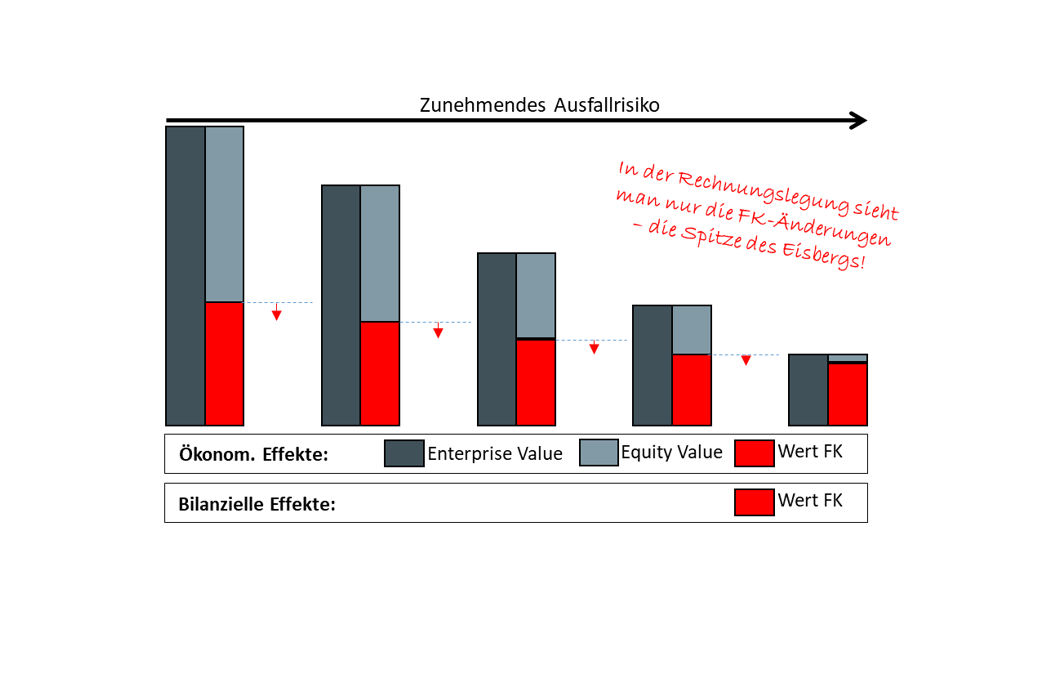
A deterioration in credit standing is usually caused by a riskier business environment and a reduction in enterprise value. Moreover, the reduction in enterprise value falls more heavily on equity investors than on debt investors. Own credit gains are therefore only the tip of the iceberg, and a misleading tip at that. What appears positive actually implies something much more negative. The following chart illustrates how the different components of value change as default risk increases.
Original figure, explained in English
Default risk increases from left to right. Under economic effects, dark grey represents enterprise value, blue-grey represents equity value and red represents debt value. Under accounting effects, only the changes in debt value are shown. The red annotation explains that the accounts reveal only those debt changes, the tip of the iceberg.
Equity is affected more severely because of its position in the order of payment: debt has priority over equity. For a precise account of how changes in enterprise value are distributed between equity and debt, see the Merton model, which also underlies the calculation above: Merton (1974), ‘On the Pricing of Corporate Debt: The Risk Structure of Interest Rates’, Journal of Finance, 29, pp. 449–470.
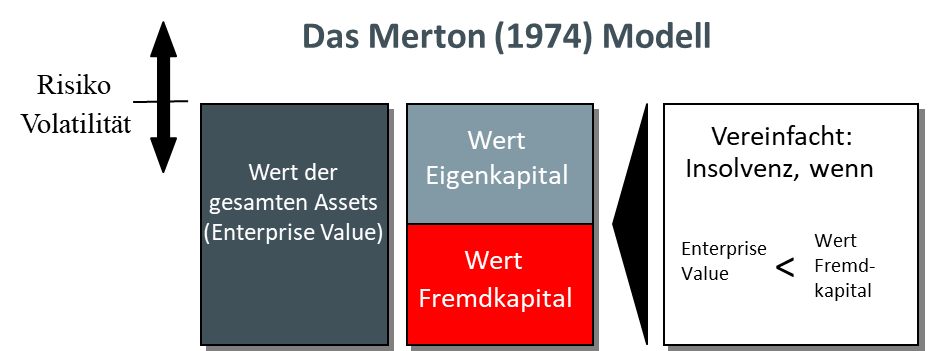
This model is a precursor to modern option pricing theory and values capital claims according to the probability of future payment. It starts from the observation that enterprise value is subject to risk and fluctuations, which affect its distribution between the different claims.
Original figure, explained in English
The Merton (1974) model: risk is represented by volatility in the total value of assets, or enterprise value. That value is allocated between equity and debt. In the simplified illustration, insolvency occurs when enterprise value falls below the debt claim.
For business valuers, the implications are as follows:
- Viewed in isolation, an own credit gain may initially seem puzzling. It is economically justified, but tells only a small part of the story. It is, in effect, the misleading tip of the iceberg.
- An own credit gain usually arises from a reduction in enterprise value, often difficult to observe directly in the accounts, accompanied by a reduction in the market value of equity.
- Capital structure valuation models, including Merton’s 1974 model, show that the decline in the fair value of equity exceeds the decline in the fair value of debt.
- An own credit gain should therefore be a warning signal for anyone assessing business value. The valuer should identify its causes and adjust the earnings and cash flow outlook accordingly.
- As a rule of thumb, if an own credit gain does not ultimately lead to a negative effect on equity value in the analysis, something has probably gone wrong.
- IFRS 9 changed the situation only slightly. The gains no longer appear in profit or loss, but changes in equity remain. The analytical challenge is unchanged.
The own credit gain effect is not unlike the default risk financial analysis problem discussed last week. Both concern an appropriate, economically meaningful valuation of assets and liabilities.
The final word goes to former Deutsche Bank CEO Josef Ackermann. In his introduction to the 2008 annual report, when IAS 39 still applied, he explained that the bank had remained conservative in using the fair value option for its own liabilities. Applying the method to all outstanding debt would, he said, have increased 2008 pre-tax profit by EUR 5.8 billion (Deutsche Bank Annual Report 2008, p. 2). This was presumably intended as a positive, perhaps even reassuring, statement. Yet readers who understood own credit gains had greater reason for concern. The misleading iceberg strikes again.