


Three points seem fairly clear to me when it comes to business valuations for legal purposes:
- Fair compensation for minority shareholders and similar legally defined measures of business value are fundamentally economic concepts. Their purpose is to provide financial compensation for the loss of ownership in a company, which requires a valuation from the minority shareholder’s perspective. Naturally, the precise implementation is also a legal matter, as the extensive literature demonstrates.
- Procedural considerations also require practical explanations, guidance and boundaries for valuers determining fair compensation in a specific legal case. The complexity of the subject makes this necessary. Without such guidance, the costs of preparing valuation reports would often be disproportionate to their benefits. Guidance also helps safeguard minimum professional standards. The IDW’s commitment to this task in Germany is commendable in principle.
- Valuation for legal purposes must nevertheless allow room for more sophisticated analysis. Where the individual case requires it, specialists must be brought in, and the usual boundaries may cease to be helpful. Such cases arise more often than one might think.
The problem is not legal-purpose valuation itself, but the role of the IDW as a major participant in restricting this flexibility in practice. The value actually required by the legal question, the ‘correct’ valuation result, is rarely achieved. Contributing factors include questionable models such as the Tax-CAPM, a fixation on the denominator and the cost of capital, and the dismissal of comparative approaches, with multiples permitted only as plausibility checks. At the same time, the density of explanations, requirements and practical guidance substantially narrows the dispersion of valuation results. We see ‘precise’ valuations too often. In many cases, valuation for legal purposes has therefore reached a position that is particularly undesirable.
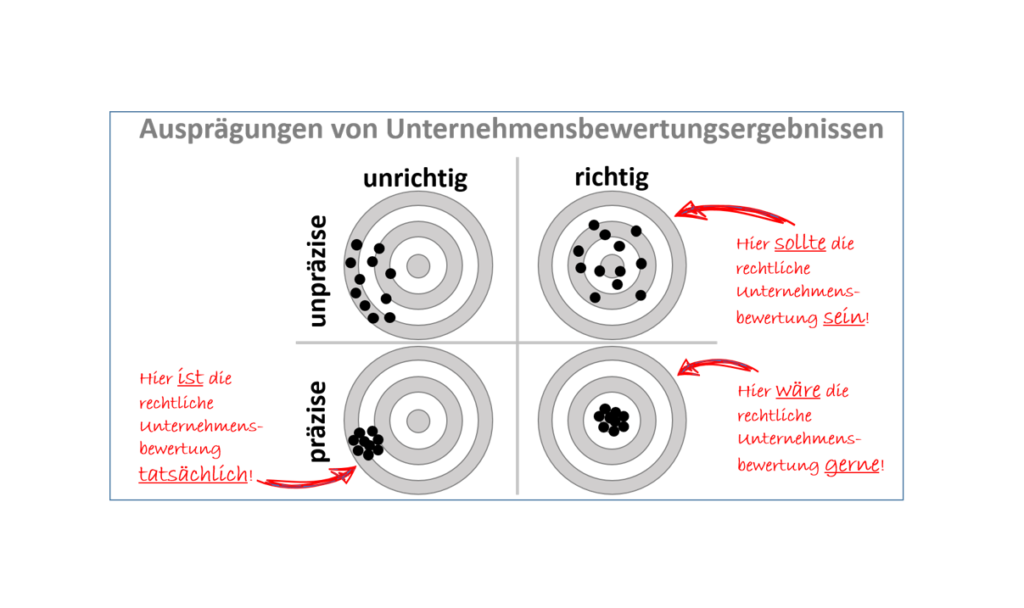
Original figure, explained in English
The matrix distinguishes inaccurate results on the left from accurate results on the right, and imprecise results above from precise results below. The author places current legal-purpose valuations in the inaccurate but precise quadrant. He argues that they should aim for accurate, even if imprecise, results. Accurate and precise results are the desired ideal.
What we need instead, particularly in larger cases, is valuation for legal purposes that produces accurate results. Those results may legitimately be imprecise. Given the complexity inherent in business valuation, economically meaningful conclusions necessarily involve a degree of uncertainty. I would go so far as to say that accurate valuations are only possible if the system does not impose artificial precision.
For more on this, including what valuers can learn from chess players, tennis players and transport system designers, see my contribution ‘Rechtliche Unternehmensbewertung: Königsdisziplin! … oder doch nur eine bunte Show?’ [Business Valuation for Legal Purposes: The Ultimate Discipline or Just a Colourful Show?], in Tönnes (ed.), Unternehmensbewertung, Festschrift für Bernhard Großfeld zum 85. Geburtstag, 2019.
Happy birthday, Professor Großfeld, a tireless advocate for a strong economic foundation in business valuations for legal purposes.
P.S. Some consolation: these problems are by no means confined to Germany:
„The last three decades have seen an explosion in valuations for legal and accounting purposes. Since neither the courts nor accounting rule writers have a clear sense of what they want as output from this process (and it has little to do with fair value), and there are generally no transactions that ride on the numbers (making them “show” valuations), you get checkbox or rule-driven valuation. In its most pristine form, these valuations are works of art, where analyst and rule maker (or court) go through the motions of valuation, with the intent of developing models that are legally or accounting-rule defensible rather than yielding reasonable values. Until we resolve the fundamental contradiction of asking practitioners to price assets, while also asking them to deliver DCF models that back the prices, we will see more and more Kabuki DCFs.“
Source: Damodaran, Musings on Markets, 23 February 2015, http://aswathdamodaran.blogspot.com/2015/02/dcf-myth-1-if-you-have-ddiscount-rate.html. Kabuki is a traditional form of Japanese theatre.