

Cash flows are lumpy. A company pays for an asset in one year and earns from it over many. Accrual accounting turns this into a measure of performance per period. The IASB's Conceptual Framework describes it as depicting the effects of transactions in the periods in which they occur, even when cash moves at a different time, and values it as a better basis than cash flows alone for assessing past and future performance (CP 1.17).
But whenever we deviate from pure cash accounting, we need assumptions and estimates, and estimates are always fragile. In other words, the benefit of measuring performance per period comes at the cost of subjective estimates. In most cases this works well and the benefits outweigh the costs (I am a firm believer in the accrual principle). But in some cases it does not…
Ayvens: Performance built on estimates
Ayvens is a leasing group formed in 2023, when ALD Automotive acquired LeasePlan, and is majority-owned by Société Générale (54.8%; AR 2025, p. 304). It carries about 2.5 million vehicles on its balance sheet (AR 2025, p. 38). The operating business model is simple: Ayvens buys a car, leases it to a company, typically for three to five years (AR 2025, p. 21), and sells it afterwards. The monthly lease rate covers four components: the expected loss in value, interest on the capital tied up, services such as maintenance, and a margin (Figure 1).
The expected loss in value is the critical component. It equals the purchase price minus the price at which the car is expected to be sold at the end of the lease (the residual value). This residual value sits at the centre of Ayvens' whole performance model.
In fact, somewhere at Ayvens, someone writes down today what, say, a Passat will be worth in autumn 2030. The estimate enters the lease rate and the depreciation charge from the first month; the used-car market reveals the true value only years later. Until then, Ayvens revalues its fleet car by car at least once a year, and twice a year in entities with more than 10,000 vehicles (AR 2025, p. 322).
How quickly the used-car market can turn shows in Ayvens' 2026 half-year report. Rising oil prices had lifted demand for electric cars in some countries and cut it for combustion cars in others, reversing the trend so far; Ayvens called it "premature to conclude whether this is a start of a new trend" (HY 2026, p. 36).
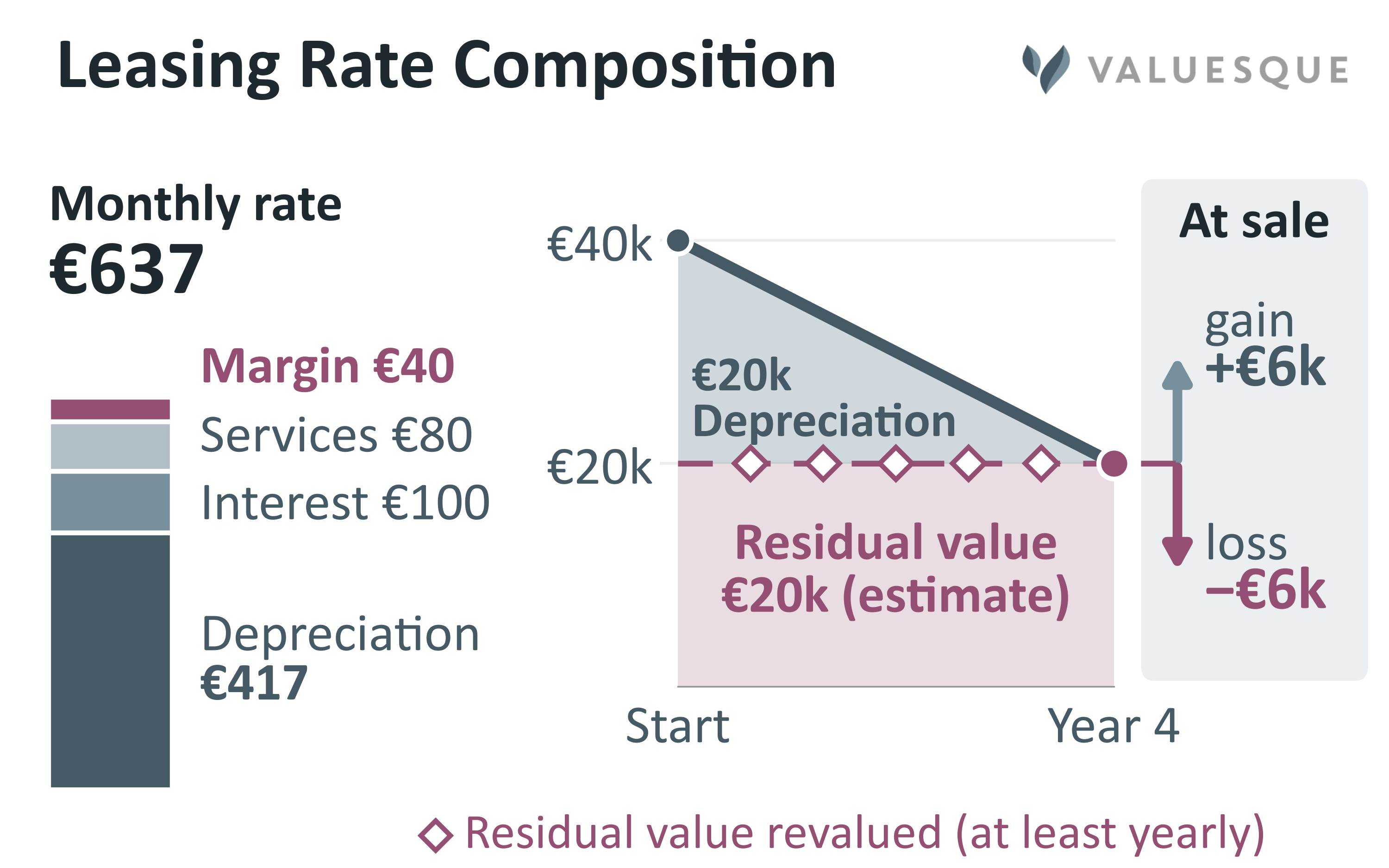
Figure 1: Illustrative operating lease of a €40,000 car. Residual value about half of cost, as in Ayvens' fleet (AR 2025, pp. 38, 339).
The quantitative relevance of estimates
Ayvens' 2025 annual report quantifies how much depends on the residual value estimates. Of the €51.2bn at which the rental fleet stands in the balance sheet, €34.8bn, i.e. 68%, are residual values (AR 2025, p. 38). If Ayvens expected €1,000 less per car, profit would fall by €315m, 22% of 2025 pre-tax profit of €1.41bn. A €1,000 increase would add €187m, 13% of pre-tax profit (AR 2025, pp. 37, 340). Ayvens presents these numbers as the net impact on the income statement and leaves the time horizon open.
To put this sensitivity into perspective: €1,000 is a modest estimation error, about 7% of an average residual value of roughly €13,800 per vehicle (€34.8bn divided by 2.5 million vehicles; our calculation). Measured as the standard deviation of annual changes, used-car prices in Ayvens' six largest euro-area fleet countries moved by about 4% a year between 2016 and 2025, or roughly €550 per vehicle (fleet-weighted; Eurostat HICP, our calculation). Over a four-year lease term, the typical swing was about 9%, or roughly €1,200. Scaled with Ayvens' sensitivity, a fall of the 4-year volatility would cost about €390m, this is 28% of 2025 pre-tax profit!
How does Ayvens perform against a perfect estimate?
How much does this matter for the annual result? Suppose Ayvens had known every future sale price (perfect foresight) and set each residual value accordingly. We rebuilt the depreciation path under such a perfect estimate and compared the result with actually reported pre-tax profit (Figure 2). The inputs are the reported sales results, cars sold and residual value adjustments from the annual reports of ALD (2016–2022) and Ayvens (2023–2025).
Two assumptions are needed. First, an average lease term of four years (Ayvens' contracts average 47 months; AR 2025, p. 21). Second, a gain of €400 per car sold from 2026 onwards. (the latter matters because the perfect residual value of every car still on lease at the end of 2025 depends on the price it will realise in 2026 to 2028, which nobody knows yet; €400 is the mid-point of Ayvens' 2026 guidance of €200 to €600 per car (AR 2025, p. 46)).
The deviation runs in both directions and exceeds 10% of reported pre-tax profit in seven of ten years. In 2020 alone, reported pre-tax profit fell short of the perfect-estimate figure by €0.5bn, or 81% of the reported amount: the fleet contained cars that would later sell at record prices, and depreciation had been charged on residual values far below those prices. In 2022, when those gains arrived, the gap reversed: €0.57bn, or 34% of reported pre-tax profit. On average, the gap was 23% a year. Over ten years, however, the deviations almost cancel out.
Admittedly, the perfect estimate is a tough benchmark; nobody could foresee the used-car boom that followed Covid and the chip crisis. The figure therefore shows how strongly Ayvens' result depends on the residual value, rather than how well Ayvens estimated. In other words, the problem would remain even with a perfectly rational and honest management.
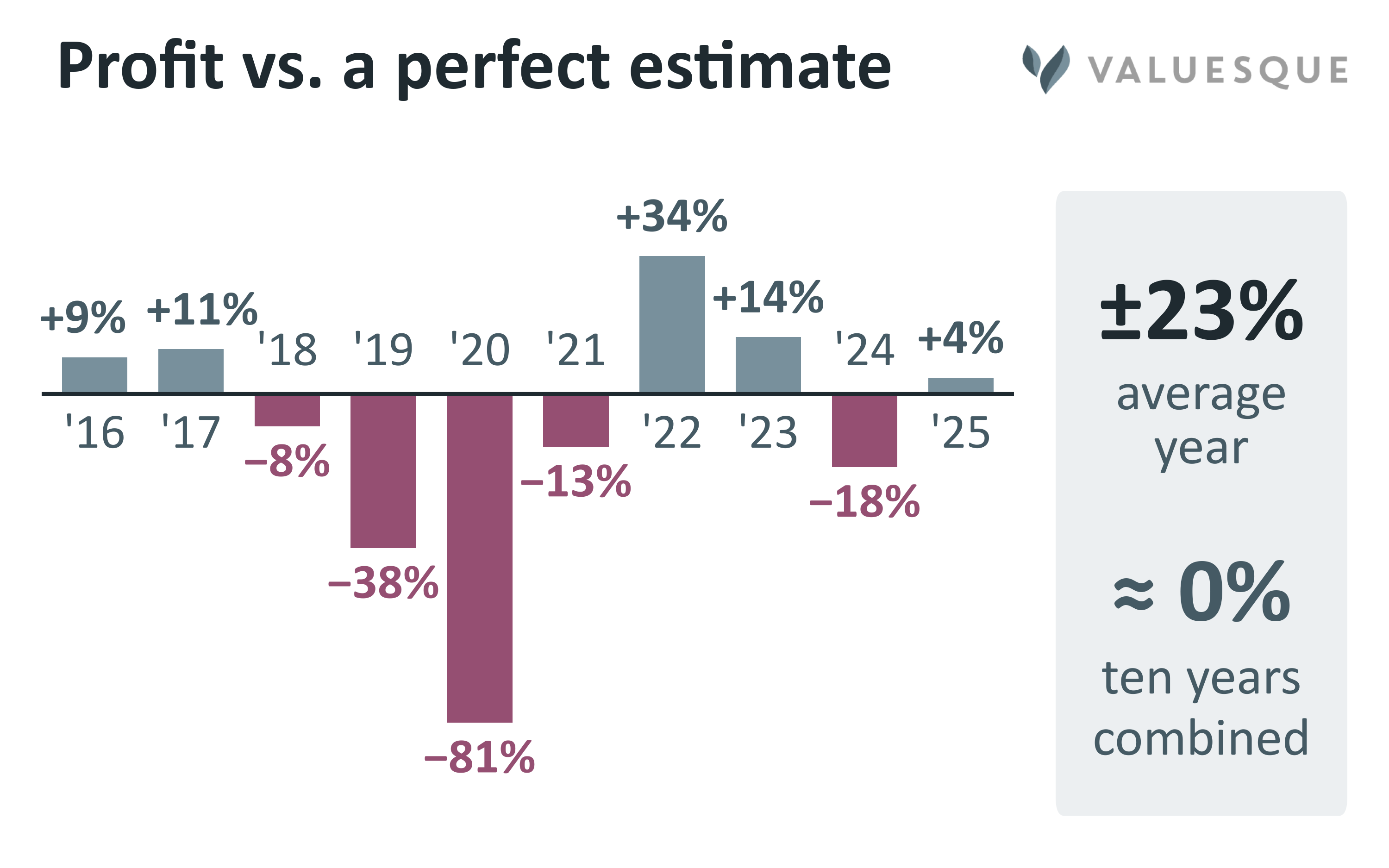
Figure 2: Reported minus perfect-estimate pre-tax profit, in % of reported. Thought experiment: shows dependence on the residual value, not estimation quality. Four-year leases; €400 gain per car sold from 2026. Valuesque calculation.
Reporting cycle vs. business model cycle
Over the whole life of a single car, the residual value estimate only shifts profit in time. The sum of depreciation, net of any gain on sale, always equals purchase price minus sale proceeds; the estimate merely determines when the profit appears and in which line. In financial reporting practice, this is of limited comfort, for three reasons.
Annual profit is what counts. Dividends, valuations and bonuses rest on twelve-month figures, the normal reporting cycle. A correction in 2028 leaves the 2025 dividend in place.
Good news arrives late, bad news early. Downward revisions of residual values are spread over the remaining lease term as soon as they are identified, which raises the depreciation charge in every remaining period (IAS 16.51, IAS 8.36; AR 2025, p. 334). Upward revisions can at most stop depreciation (IAS 16.54); anything beyond that appears only on sale. This is one possible reason for the gap between €315m (downward) and €187m (upward) in Ayvens' sensitivity (AR 2025, p. 340). An interesting detail: ALD, Ayvens' predecessor, began cutting depreciation for expected gains only in the first half of 2022 (ALD HY 2022, p. 7); until then, it recognised them on sale (ALD AR 2021, p. 187). This switch, made at record used-car prices, brought forward about €865m into ALD's leasing contract margin, as then reported, of 2022 and 2023 (ALD AR 2022, p. 39; AR 2023, p. 43).
Economically, an estimation error is real. The lease rate is priced on the basis of the initial residual value estimate. An overestimated residual value works as a discount for the customer (a cheaper lease rate), an underestimated one as a price premium (a more expensive lease rate). In a competitive market such as car leasing, such mispricing reaches well beyond the single contract: into prices, volumes and the mix of contracts written.
All this leads to the question of how long a reporting period would have to be, if there were a choice, for the swings to wash out. Rolling windows over 2016–2025 provide an answer (Figure 3). Over one year, the deviation from the perfect-estimate profit averages 23% of reported pre-tax profit. Over four years, one contract generation, it falls to 14%, and it drops to about 4% at seven years. The message is clear: Ayvens' business runs on a market cycle, while its reporting runs on twelve months.
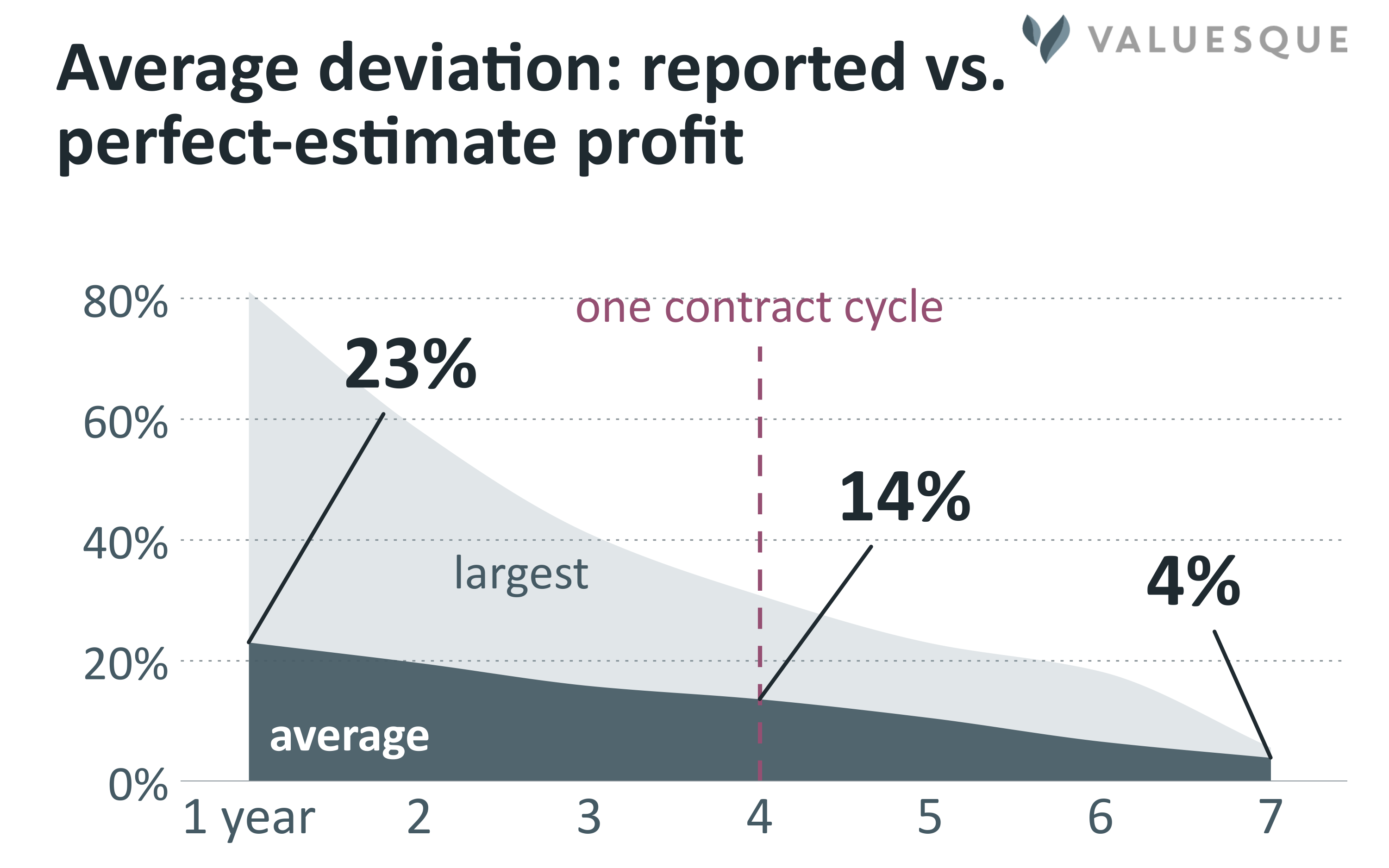
Figure 3: Average absolute deviation of reported from perfect-estimate pre-tax profit, in % of reported, by length of period. Rolling periods 2016–2025, one boom cycle. Dark band: average; light band: largest. Same thought experiment as in Figure 2.
Summary
Accrual accounting needs estimates, and at Ayvens one estimate dominates: the residual value of leased cars. It decides when profit appears; the used-car market decides how much. Measured against a perfect estimate, reported pre-tax profit deviated by 23% in an average year and by 14% over four years, one contract generation.
For analysts, this means that short-term forecasts will often miss, however careful the model, because the key input is the price of a used car several years from now. Single-year results and single-year forecasts deserve wide error bands. What counts is the long view: profit over a full contract generation, judged against a full used-car cycle.