

A regulated utility does not set its own prices. A regulator does, and the regulator also decides which year's prices pay for which year's work. A network can do the work in one year and only be allowed to charge for (parts of) it several years later.
Accounting has had no place for that gap. IFRS 15 gets the timing right: revenue is recognised when the performance obligation is satisfied, i.e. when the work is done (IFRS 15.31, p. A767). The amount, however, is the consideration the company is entitled to "in exchange for transferring promised goods or services to a customer" (IFRS 15.47, p. A771), which in practice means this year's tariff. If the regulator has shifted part of the compensation for this year's work into later years' tariffs, for example because it allows certain costs such as tax only when they are paid in cash (IFRS 20.B24), that part is not in this year's revenue. It will be paid by future customers, not by the customers served today.
Reported earnings therefore follow the regulator's price-setting rather than the full compensation for this year's work. The IASB considered handling this with IFRS 15-style revenue principles and decided against it. A regulatory balance is not a retrospective adjustment to the price of a past supply, and the customers who pay it later are not necessarily those who were supplied. Treating the whole customer base as one customer would not fit IFRS 15's focus on individual contracts (ED/2021/1, Basis for Conclusions, BC53, p. 19, BC73–BC74, pp. 24–25).
In May 2026, however, the IASB closed this gap with IFRS 20 Regulatory Assets and Regulatory Liabilities, effective for annual periods beginning on or after 1 January 2029, early application permitted. Each jurisdiction endorses it separately: the EU is considering a one-year deferral to 2030.
How IFRS 20 works
The idea is: A company should report what it earned in a particular period, regardless of whether it relates to the performance obligation or to the regulator’s adjustments.
Two new items make that possible:
A regulatory asset: an enforceable present right, created by the regulatory agreement, to add an amount to future prices, because part of the compensation for what the company has already supplied is not yet in IFRS 15 revenue.
A regulatory liability: the mirror: an obligation to deduct an amount from future prices, because IFRS 15 revenue already includes compensation for services still to be supplied in the future.
The changes in these assets and liabilities are recognised as regulatory income or regulatory expense, classified as revenue and shown as a separate line item.
Typical cases are costs a regulator compensates on a different timetable from the accounts: pensions and decommissioning allowed only when the cash is paid, recoverable storm costs, income tax allowed on a cash basis, and revenue over- or under-recovered against the cap.
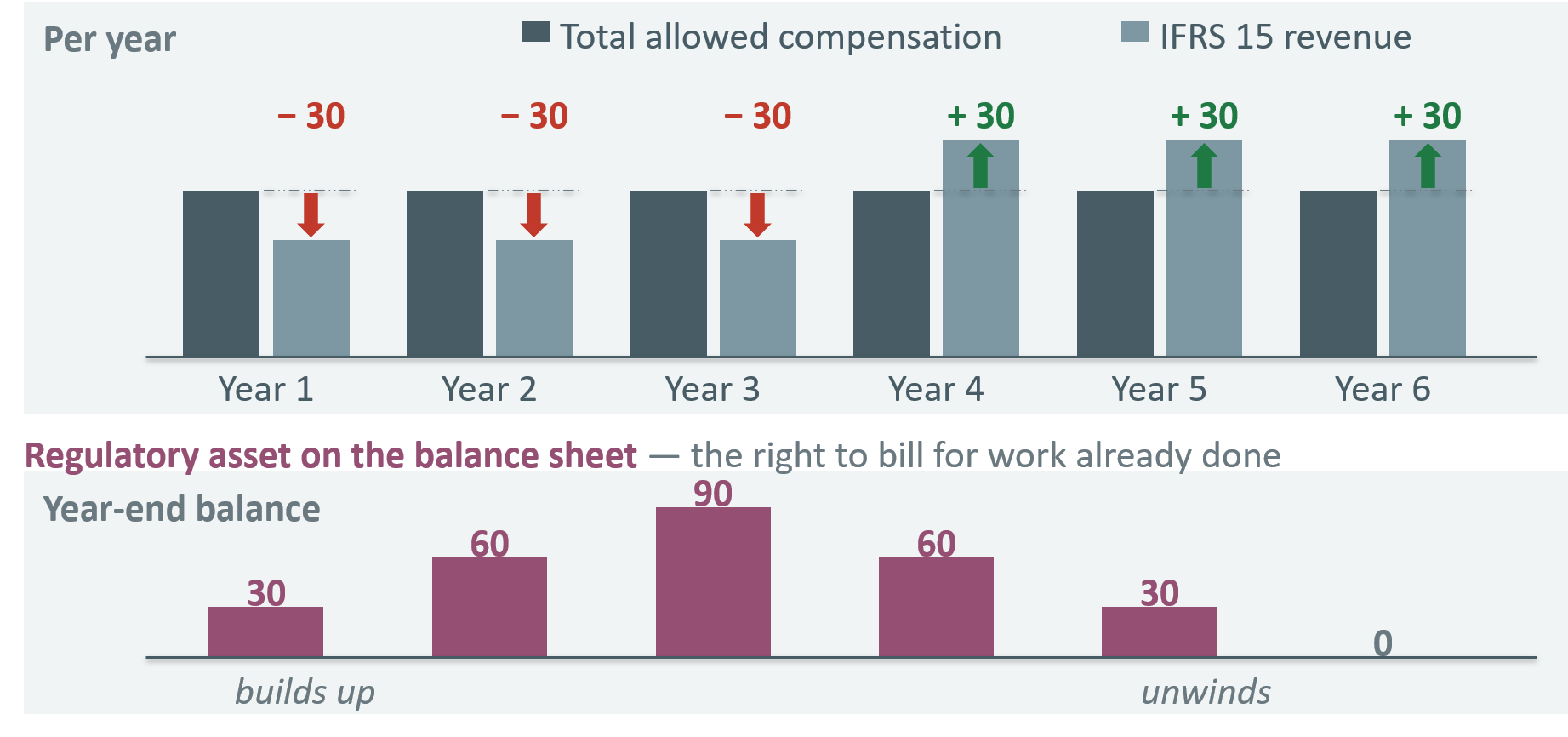
Illustrative figures, one investment in isolation
Ofgem's immediate tax adjustment
Under the UK RIIO (“Revenue = Incentives + Innovation + Outputs“) regulatory framework, regulated network operators receive a tax allowance as part of their regulated revenues. This allowance is intended to compensate operators for cash taxes incurred in the respective period and the mechanism is designed to broadly neutralise the period-by-period cash-tax burden of regulated utilities.
This mechanism became particularly interesting following the introduction of the UK’s “full expensing” regime in 2023. Full expensing allows qualifying investments in plant and machinery to be deducted immediately (and in full) for tax purposes rather than through writing-down allowances spread over many years (long-life assets get a 50 % first-year allowance). For network operators undertaking substantial investment programmes, this results in a significant front-loading of tax deductions (or back-loading of tax payments).
As a consequence of the period-by-period tax matching idea in RIIO, Britain's energy regulator Ofgem reduced the initial regulated revenue in line with the lower initial tax payment duties, and increased the regulated revenues for the later periods when higher cash taxes have to be paid by utilities. From a cash-flow perspective, the regulatory mechanism therefore broadly offsets the timing benefit created by accelerated tax deductions: the back-loading of tax payments (full expensing) is accompanied by a back-loading of regulatory remuneration (RIIO).
This cash neutralisation itself was subject to a lot of criticism from grid operators (as the idea of full expensing was intended to benefit companies in cash timing in order to incentivise for capital expenditures), but in this article we focus on the IFRS accounting effects only.
And these accounting consequences are quite asymmetric. While current tax expense declines due to full expensing, the immediate reduction in the tax base of the underlying assets creates taxable temporary differences and, consequently, deferred tax liabilities and deferred tax expenses in the IFRS accounts.
In the accounts, the reduction in current tax expense is thus offset by an increase in deferred tax expense: the tax saving never reaches IFRS profit. At the same time, regulated revenue according to IFRS 15 declines in line with Ofgem’s lower current-period tax allowance. Revenue falls while the tax saving that caused the cut is booked back as deferred tax, so net earnings fall. I.e. despite cash neutrality of the mechanism the accounting effect is negative on reported IFRS net earnings.
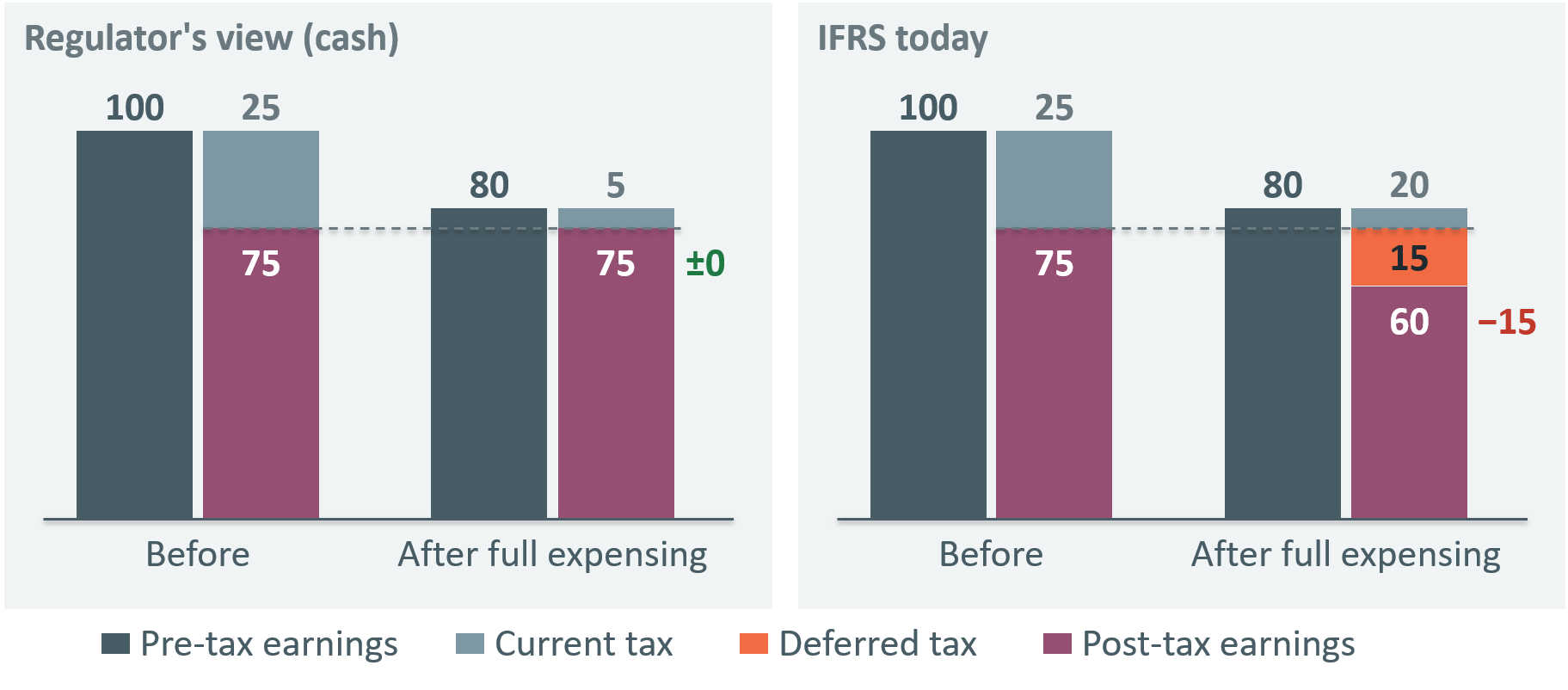
Illustrative figures, 25 % tax rate. Capital allowances save 15 of cash tax; the regulator cuts revenue by 20 (15 ÷ 0.75).
And for continuously investing network operators, this earnings depression effect may stay for longer at company level. While deferred tax liabilities associated with individual investments unwind over time, ongoing capital expenditure continuously creates new temporary differences and deferred tax liabilities.
Every network under a British price control is affected by this counter-intuitive effect. Two of Europe's largest operators are the clearest about it in public: National Grid, which owns the transmission network in England and Wales and Britain's largest distribution network, and Iberdrola, the Spanish group behind ScottishPower's networks and Electricity North West. Iberdrola made clear what it thinks about this situation:
"Net Profit artificially depressed in Regulated companies." (Iberdrola, Capital Markets Day 2025, Financial Management, p. 37)
Will IFRS 20 be able to catch this?
The standard names the fact pattern: a timing difference arises if the regulator provides compensation "for current tax expense or income but not for deferred tax expense or income for that period" (IFRS 20.B24). Its worked example is this one, a deferred tax liability the regulator pays for only when the cash tax falls due (IFRS 20, Illustrative Examples, Example 16).
So the balance gets recognised. What is open is how big it is. A price control runs five years; the capital allowances reverse over decades, and both KPMG and United Utilities asked the IASB in 2021 whether an asset of this kind is recognised in full or cut off at the boundary of the agreement (comment letters on ED/2021/1). As far as we know, this question is still unanswered. The UK Endorsement Board planned to meet Ofgem in June and July and will field-test the standard with an energy company from October (UKEB, IFRS 20 Project Initiation Plan, July 2026, p. 9).
Iberdrola and National Grid with home-made fixes
Both Iberdrola and National Grid have built a correction outside their official accounts – but the two are not alike.
Iberdrola treats it as a reconciling item between reported and adjusted net profit, on its own line, "Capital Allowances (UK)", just below the tax line (Iberdrola, Results Report H1 2026, p. 32). The add-back was €251 million in 2025 (Results Report FY2025, p. 31), €181.8 million in the first half of 2026 (Results Report H1 2026, p. 30), and €297 million over the twelve months to June 2026 (Results Report H1 2026, p. 46). Iberdrola told investors the effect would grow from about €100 million in 2024 to about €300 million by 2028 (CMD 2025, Financial Management, p. 37) — a level almost reached — and its capital market guidance is stated including the adjustment (pp. 24–25).
National Grid does the fix twice. It removes the deferred tax charge of its UK regulated businesses from underlying earnings: £499 million in the year to March 2026, after £401 million in the previous year (National Grid, Annual Report 2025/26, p. 73), because UK regulated revenues "contain an allowance for current tax, but not for deferred tax" (p. 237). And in its Regulated financial performance it runs an IFRS 20 calculation by hand: "UK regulatory notional deferred taxation adjustment", £276 million in Electricity Transmission and £36 million in Electricity Distribution, £312 million together, after £253 million the year before (p. 242). The definition is almost the standard's wording: recovering "cash taxation cost including the unwinding of deferred taxation balances created in the current year", "grossed up at full UK statutory tax rate" (p. 243).
Neither of the two companies directly corrects revenue or EBITDA. But the distortion starts in the revenue line, so the adjusted operating figures still carry it. Additionally, under IFRS 20 the effect is larger than the published net-profit adjustments suggest. This is the case as the extra revenue is itself taxable, so both the regulator and the standard (IFRS 20.B25) gross it up: This is Ofgem's "tax allowance on tax allowance" (Ofgem, RIIO-GD2 Price Control Financial Handbook, ch. 6, p. 48).
We ran the numbers on each company's last financial year, on two assumptions: the extra revenue is grossed up at the UK tax rate of 25 %, and the regulatory asset covers the full deferred tax liability (IFRS 20.60), recovered over the whole life of the assets. National Grid's £499 million then becomes about £665 million of revenue and EBITDA, 11.7 % of underlying operating profit (Annual Report 2025/26, p. 73). Iberdrola's €251 million, which the company does not define and we read as after tax, becomes about €335 million, 2.1 % of adjusted EBITDA and 18 % of its UK networks' EBITDA (Results Report FY2025, pp. 31, 35). Net profit rises only by the original amounts; the rest is deferred tax. These are upper bounds: if only the current five-year price control counts, the amounts are smaller. National Grid's own grossed-up figure, £312 million, points to how much smaller. Either way, the item lands at the top of the income statement.
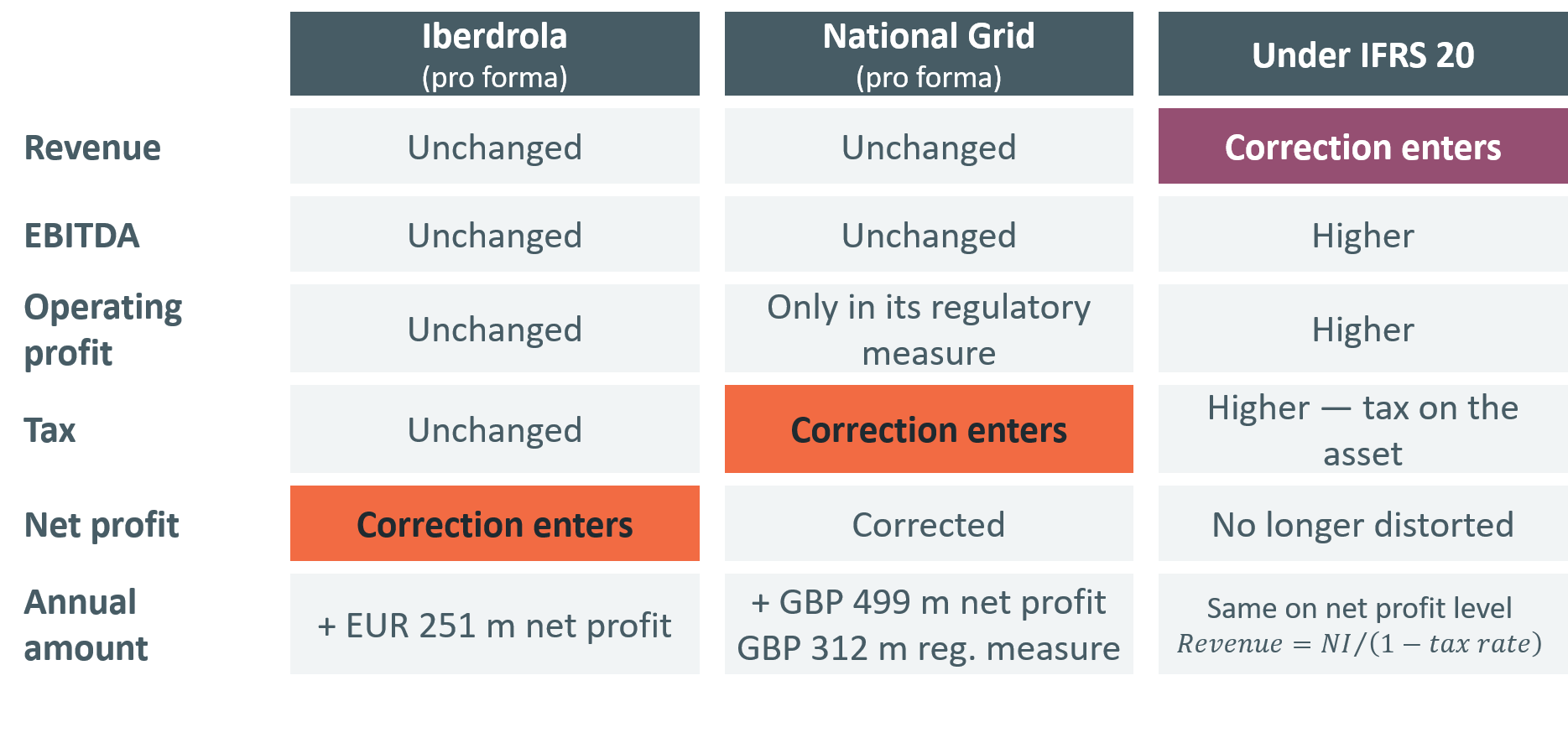
Amounts: Iberdrola 2025, National Grid the year to March 2026; GBP 665 m assumes the full GBP 499 m is compensated. Iberdrola corrects FFO and RCF for capital allowances in its credit metrics, outside the income statement. Balance sheet today: the deferred tax liability alone; IFRS 20 adds the regulatory asset beside it.
For now the regulatory assets would still grow (if IFRS 20 were already in place): both groups are still investing, the tax capital allowances keep running ahead of accounting depreciation, and the amount to be recovered rises each year. National Grid's first IFRS 20 period begins 1 April 2029. Iberdrola's begins 1 January 2029, or 1 January 2030 if the EU decides on the deferral it is still assessing. Let’s wait and see with which numbers the two groups enter the new standard.
What changes IFRS 20 brings to rate-regulated utility investors
IFRS profit stops moving when nothing has happened. The dip and the later rebound largely disappear. Earnings track the business, not the timing of a tax deduction.
Comparability improves. One rule replaces the home-made corrections companies use today. Utilities under different regulators become readable against each other without reverse-engineering each company's definitions.
Timing differences stop looking like losses. The IASB's own supporting example for introducing IFRS 20 is the 2022 energy crisis: transmission operators took on large costs to keep grids stable, with an enforceable right to recover them later. With nowhere to record that right, they reported upfront losses, "which could be misinterpreted by users of financial statements" (IASB, IFRS 20 Effects Analysis, May 2026, p. 16). The tax case is the same mechanism in a quieter setting.
EBITDA-based credit metrics move. In the IASB's fieldwork, 40 % of the participants who answered expect a positive effect on their debt covenants, 37 % on their distributable reserves (p. 43, Figure 9), all of this in a sector massively geared against net-debt-to-EBITDA.
No investment recommendation. Just my personal views based on imperfect information. Do your own research.