

On February 25, 2026 Gerresheimer announced with regard to ongoing investigation activities regarding its annual report 2024, that Germany’s financial supervisory authority BaFin has “concrete evidence that…the lease liabilities reported in the balance sheet with a carrying amount of €65.5 million and/or the undiscounted payment obligations corresponding to the lease liabilities disclosed in the notes may be incorrect.”
I.e. the current investigation is not limited to the (discounted) lease liabilities but also covers the undiscounted payment expectations that form the basis for the lease liability calculations.
Leasing activities at Gerresheimer
In its annual report 2024 (AR 2024), Gerresheimer provides fairly extensive commentary on leasing activities. In general, leases at Gerresheimer mainly concern “warehouses, office buildings, land, production machinery, and vehicles.” And: “The lease terms generally range between 30 and 60 months.” (both AR 2024, p. 67).
Leasing does not play a major role at Gerresheimer from a quantitative point of view as leasing liabilities only make up about 5 % of total financial liabilities. Nevertheless, misstatements with (presumably) small impact are also misstatements.
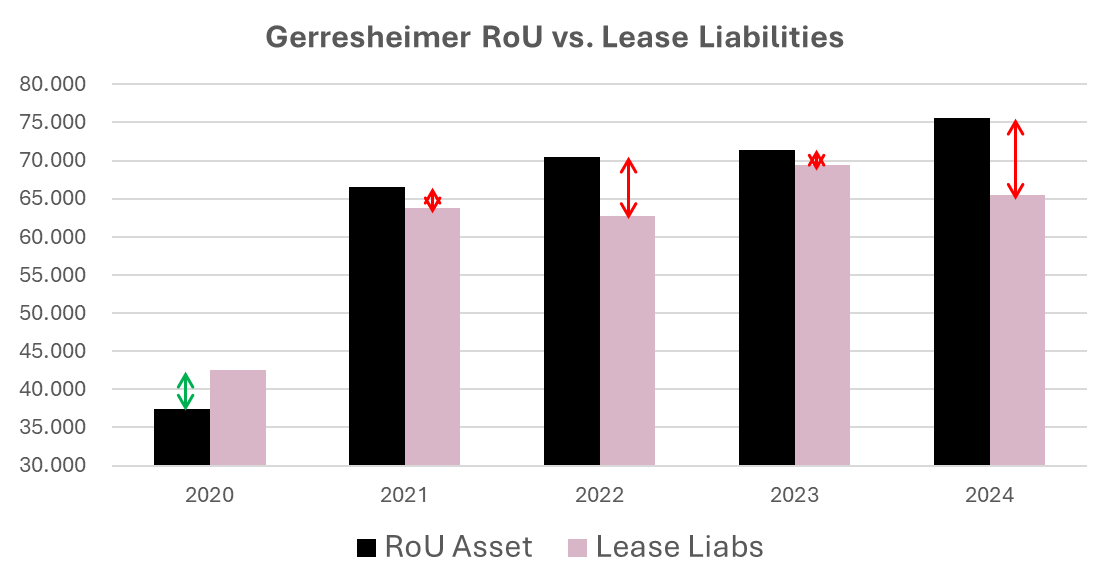
When looking at lease liabilities of Gerresheimer, two aspects are particularly noteworthy. First, lease liabilities are lower than lease assets and second, the average discount rate for leases has steadily increased to quite elevated levels over the years.
I) Lease Liabilities vs. Right-of-Use-Assets
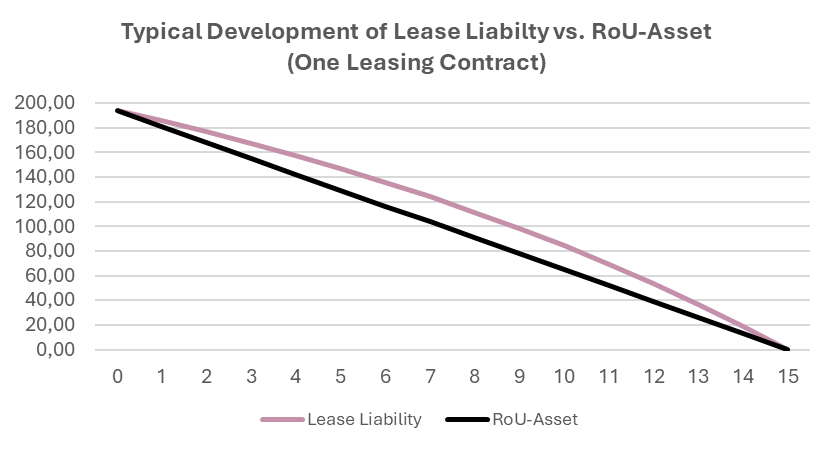
The first topic (Lease Liabilities lower than Right-of-Use-Assets) requires a bit more background on lease accounting. Under IFRS 16, lease liabilities are typically higher than right-of-use (RoU) assets over most of the lease term. The reason lies in the mechanics of measurement: lease liabilities are amortized using the effective interest method, meaning early lease payments contain a larger interest component and a smaller principal reduction. In contrast, ROU assets are usually depreciated on a straight-line basis over the lease term. As a result, the asset decreases faster than the liability, making the lease liability generally larger during most of the lease period.
The following figure highlights this for a single hypothetical lease contract over 15 years, with annual lease payments at 20 Euros and a discount rate of 6 % (numbers are chosen to highlight the differences a bit clearer). As can be seen, due to the concave nature of the lease liability development RoU assets are regularly smaller than lease liabilities.
Usually, a systematic situation where the RoU assets exceed lease liabilities arises only when additional components increase the asset but not the liability. Examples:
Prepaid lease payments (IFRS 16.24(b)). Unclear whether this applies for Gerresheimer.
Initial direct costs such as broker or legal fees but also initial fit-out costs for real estate (IFRS 16.24(c)). If fit-out costs for real estate are high this might be an explanation for the positive difference of RoU assets and lease liabilities.
Restoration or dismantling obligations in connection with the RoU asset. The present value of these expected payments is usually added to the RoU asset but recognized separately on the liability side as a provision (IFRS 16.24(d)). However, this is also unlikely in the case of Gerresheimer as environmental (695 kEUR) and other (2,663 kEUR) provisions are rather low according to AR 2024.
In rare cases: Reassessment of leases that lead to lease modifications or remeasurements (e.g. IFRS 16.40). Unclear whether this applies here.
As we can see from the development of RoU assets and lease liabilities at Gerresheimer over time (below figure), while in 2020 lease liabilities were still higher than lease assets, this changed starting in 2021. In 2024, RoU assets exceeded lease liabilities by more than 15 %.
II) Discount Rate for Leases
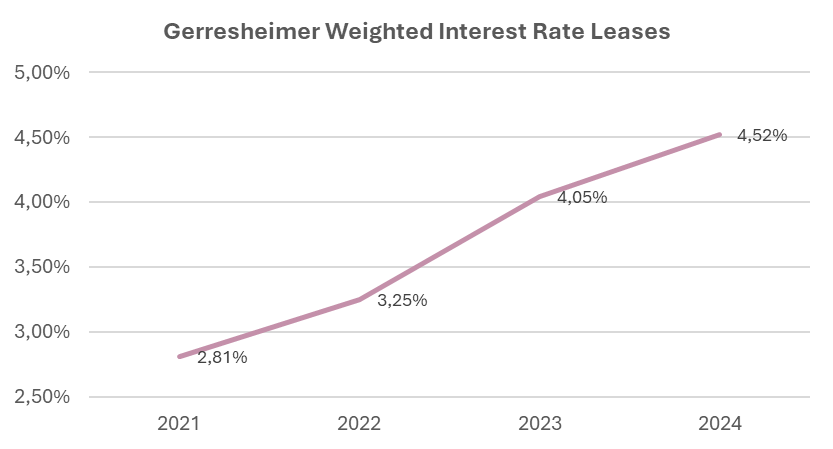
The second topic (increasing average discount rate) for leases is highlighted in the figure below. In this figure the weighted interest rate for leases is calculated by dividing the annual interest expense for leases by the average lease liability of the respective year (mean of beginning and ending lease liability).
“The lease payments are discounted using the interest rate implicit in the lease. If that rate cannot be readily determined, Gerresheimer uses its incremental borrowing rate.” (AR 2024, p. 53)
This is exactly what IFRS 16 requires. Lease liabilities are discounted using either the interest rate implicit in the lease or (if that cannot be readily determined) the lessee’s incremental borrowing rate (IBR) (IFRS 16.26). In practice, most companies rely on the IBR, which is rarely disclosed in detail and often remains a black box. As a result, investors typically cannot directly observe the discount rates embedded in reported lease liabilities.
The above derivation is just a useful proxy. It is however important to note, that the increase of this weighted average interest rate over time reflects only an average across the lease portfolio. Lease liabilities are generally not remeasured when market interest rates change (IFRS 16.36-37). Therefore, older leases at Gerresheimer still reflect historically low rates, suggesting that the true discount rate for new leases has likely risen more sharply than we can see from the figure above.
Beyond these two observations, there are also other factors that may potentially lead to distortions in the case of Gerresheimer.
III) Prolongation options
“Periods covered by options are considered when determining the lease term if the lessee is reasonably certain to exercise or not to exercise the option, as the case may be.” (AR 2024, p. 23)
IFRS 16 requires the lease term to include optional extension periods if the lessee is reasonably certain to exercise the option (IFRS 16.18–19). “Reasonably certain” is a high threshold and requires consideration of economic incentives, contractual penalties, asset specificity, and the importance of the asset to operations (IFRS 16.B37–B40). Companies assess factors such as relocation costs, business disruption, or the existence of alternative assets. If exercising the option is economically compelling, the extension period must be included in the lease term and therefore increases the recognized lease liability.
In practice, however, the assessment leaves a lot of room for judgment. Telecom analysts know this all too well from the treatment of infrastructure tower leases of telecommunication companies. Operators may lease a tower for a short initial term while arguing that renewal options are not reasonably certain, even though the infrastructure is essential and relocation is unrealistic. Economically, a tower built for a 15-year life is unlikely to be leased only briefly, and both parties typically expect long-term use (sometimes there are allegedly even tacit prolongation agreements in place). As a result, lease liabilities for towers are often lower than they should be from an economic point of view.
It is unclear here whether Gerresheimer has correctly assessed the prolongation probabilities or not. So no conclusions here regarding this point.
The wording of Gerresheimer in the AR (see above) is, however, misleading. The question is only whether it is reasonably certain whether the company exercises the option (to prolong or to terminate). It is not at all relevant whether it is reasonably certain that the company does NOT exercise the option (“…reasonably certain to exercise or not to exercise the option, as the case may be.”)
IV) Variable Lease components
“The lease liability is measured at the present value of the future lease payments. Lease payments include fixed payments, payments that depend on an index or a rate…” (AR 2024, p. 53)
This is in line with IFRS 16: lease liabilities are measured as the present value of future lease payments. These include fixed payments and variable payments that depend on an index or a rate, such as CPI-linked rents or interest-rate-based adjustments (IFRS 16.27(b)). In contrast, variable lease payments that depend on future performance or usage are excluded from the initial lease liability and are recognized in profit or loss when incurred (IFRS 16.38(b)).
Examples include turnover-based rent in retail (e.g., 5 % of store revenue), usage-based payments (such as fees per hour usage for leased equipment), or output-based arrangements (payments per unit produced by leased equipment). Similar structuring effects may arise in sale-and-leaseback transactions when lease payments are largely variable. In practice, in particular in the retail industry many leases combine a small fixed minimum rent with additional turnover rent, keeping the on-balance recognized lease liability relatively small.
However, IFRS 16 contains an anti-avoidance rule: payments that appear variable but are economically unavoidable are treated as in-substance fixed payments and must be included in the lease liability (IFRS 16.B42). This provision limits attempts to structure economically fixed obligations as variable payments.
This is a highly relevant topic in practice. However, it is again unclear here whether Gerresheimer has correctly treated any variabilities (we would need to look into the contracts). So again: no conclusions here regarding this point.
V) Short-term and low-value leases
“Exceptions apply to short-term leases with a lease term of twelve months or less and for leases of low-value assets. Leased items with a maximum value of EUR 5,000 are defined as low-value assets.” (AR 2024, p. 53)
Again, this is absolutely in line with IFRS 16 which provides recognition exemptions for short-term leases and leases of low-value assets. Short-term leases are contracts with a lease term of 12 months or less and no purchase option (IFRS 16.5a, IFRS 16.6). Low-value assets typically include items such as laptops or small office equipment (IFRS 16.5(b), IFRS 16.B3–B8). The definition of Gerresheimer above makes sense in our view.
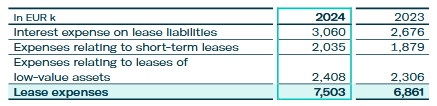
Payments for such leases are recognized directly in profit or loss. While Gerresheimer reports relatively notable payments for these leases relative to on-balance lease contracts (see below), this does not necessarily indicate a structural issue. Again: no conclusions here regarding this point.
(AR 2024, p. 67)