

Preface: This deliberately abstract and simplified account draws on recent news reports and press releases. In several important respects, it does not necessarily reflect my own analytical findings or opinions. Please read the disclaimer at the end.
Act One: The Starting Point
I own a small pub in Nuremberg. My speciality is Burg-Bier, which I brew myself. ‘Burg’ is German for ‘castle’, and Nuremberg has a beautiful castle overlooking its old town.
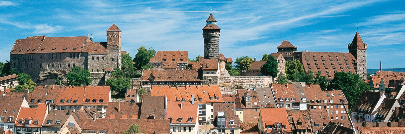
I am proud of my licence to sell Burg-Bier in Nuremberg. The pub does reasonably well, but business is hardly outstanding. Unfortunately, there is little real scope for growth in Nuremberg’s beer market. A potential investor recently approached me about buying a stake in my pub. After a brief review, however, he decided that my business proposition was not particularly interesting. Time to give things a little push…
Act Two: Early Success in Hamburg
I want to put my pub on a growth trajectory, and I have chosen Hamburg as my target market, partly because of its name: HamBURG! Buying another pub would be too expensive, however. I would also need a Hamburg beer licence, which I do not have. Instead, I enter into partnerships with existing Hamburg pubs. They will sell my Burg-Bier in return for a small fee. Unfortunately, it soon becomes clear that people in Hamburg do not like my beer at all. Hamburg no longer has a proper castle, a detail I overlooked in my research, so nobody finds Burg-Bier particularly appealing.
I am still a little disappointed when my potential investor visits me again in Nuremberg. He has heard about my expansion plans, likes them and wants to know more. Hamburg is a long way from Nuremberg, so I tell a small lie: people in Hamburg, I say, are very fond of Burg-Bier. The investor is delighted and buys a small stake in my pub business. The price is quite attractive.
Act Three: How I Hid the Non-existent Cash from My Hamburg Business
This modest success makes me realise that a bigger story about my Hamburg activities might attract more investment in my pub business. So I tell my investor that Hamburg’s pub-goers cannot get enough of Burg-Bier. In fact, I say, almost every pub in Hamburg now sells it, and customers love it more every day. This really excites the investor. He wants to buy more shares in my business, but first he would like an auditor to confirm my success. Hamburg is too far away for him to check for himself.
So I tell my auditor the same story: ‘High revenue, a few costs, healthy profits and excellent growth. That is my Hamburg business!’ The auditor believes me. Hamburg is a long journey for him too, and I provide the accounting records, which I have prepared myself. Still, he asks: ‘If you are so successful, where is the cash from Hamburg?’ He has a point. But I have an answer: ‘In Hamburg, I have a chargeback arrangement. If one of my partner pubs tries to cheat a customer on the bill, the customer can claim back three times the amount spent that evening.’ I then explain that Hamburg’s beer regulator has therefore required me to keep the cash generated in Hamburg there for now, so that I have the funds available if such fraud is discovered. ‘That is why I cannot transfer the cash to Nuremberg, at least not yet.’ This sounds entirely reasonable to the auditor. He briefly checks the cash position with my trustee, a good friend of mine who is an even better liar than I am, and is satisfied with the reply. This is a great help, because the missing cash transfers to Nuremberg were my Achilles heel. The entire grand story now takes place in Hamburg, with no link to Nuremberg and consequently no way for the auditor to check it. My investor is happy too, and buys a larger stake in my pub business.
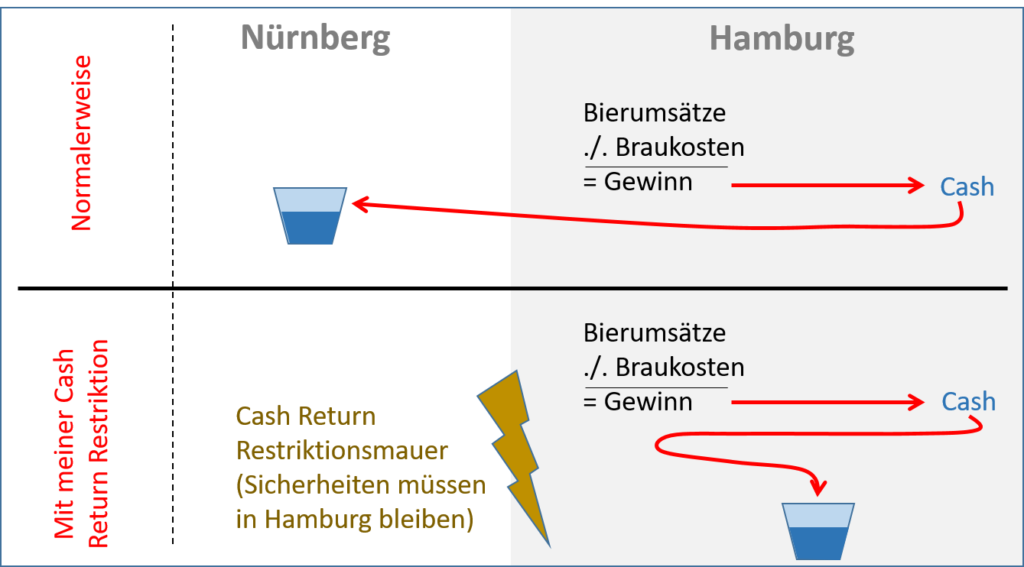
Original figure, explained in English
Normally, beer revenue less brewing costs produces profit and cash in Hamburg, which can be transferred to Nuremberg. Under the alleged cash-repatriation restriction, the collateral must remain in Hamburg, so the cash cannot be transferred.
Act Four: No Overpayment for the Pub in Wolfsburg
I now have enough money to pursue growth more actively. I decide to buy a pub in Wolfsburg, WolfsBURG!, with its own local beer licence. Admittedly, the pub is rather shabby, but I do not have enough money to buy a really good one.
My investor is enthusiastic about entering another market. He believes, however, that I have bought a market-leading pub. I can leave him with that impression by making the acquisition appear bigger and more important than it really is. I do this by paying a very high price for the Wolfsburg pub. A high price sounds like high value, does it not? To be clear, though, I do not pay that high price to the original owner. My good friend in Hamburg, the same one who ‘manages’ my Hamburg accounts, has already bought the pub for a low price that accurately reflects its condition. My pub business, funded partly by me and partly by my investor, then pays the high price to my friend. Naturally, my investor knows nothing about this arrangement.
I even make a personal profit overall. Part of the inflated price comes from my share of the pub business, but only part, because the investor contributes too. My good friend, who pockets the entire difference, has promised to reimburse my share of the overpayment and more besides. It is an excellent deal for both of us. What a lovely transaction!
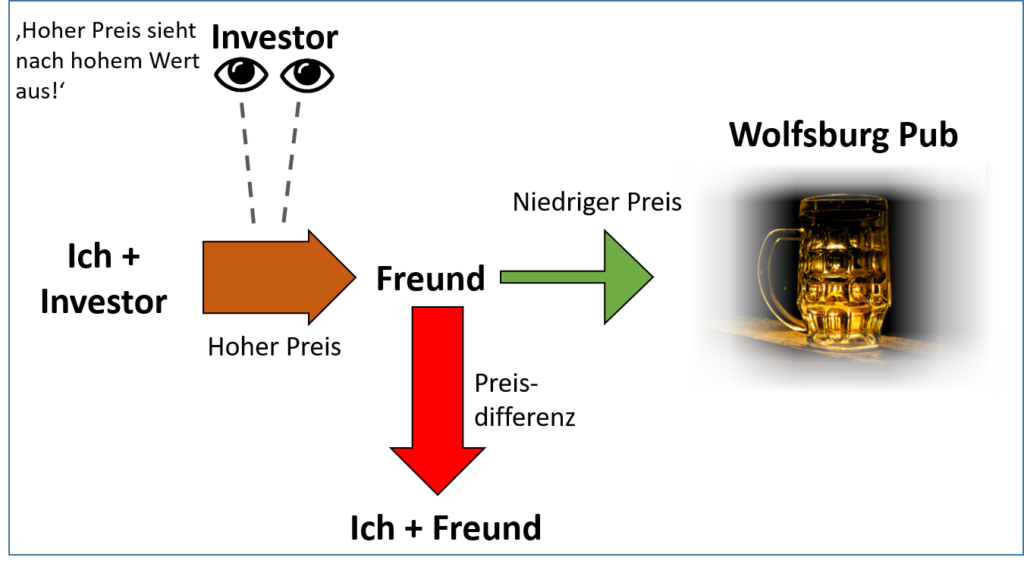
Original figure, explained in English
The investor sees a high price and assumes high value. The owner and investor pay the friend a high price, while the friend pays a low price for the Wolfsburg pub. The price difference flows to the owner and the friend.
Act Five: Passing the Beer Bottles Around
Tragically, it turns out that nobody in Wolfsburg wants to buy Burg-Bier either. Wolfsburg has a castle, but it is not as attractive as Nuremberg’s. My investor keeps calling, eager to hear success stories from Wolfsburg. I decide to give the business a helping hand. I set up an arrangement in which my partner pubs in Hamburg buy huge quantities of Burg-Bier from the Wolfsburg pub. In return, the Wolfsburg pub buys enormous quantities from the Hamburg partners. Quid pro quo! Both Wolfsburg and Hamburg now look very successful. They report such high Burg-Bier sales that I could never actually produce enough beer to supply them. But that does not matter. The sales never really happen. They exist only on paper. A neat trick: everyone looks successful, and nothing actually moves. My investor buys more shares in my pub business at ever higher prices.
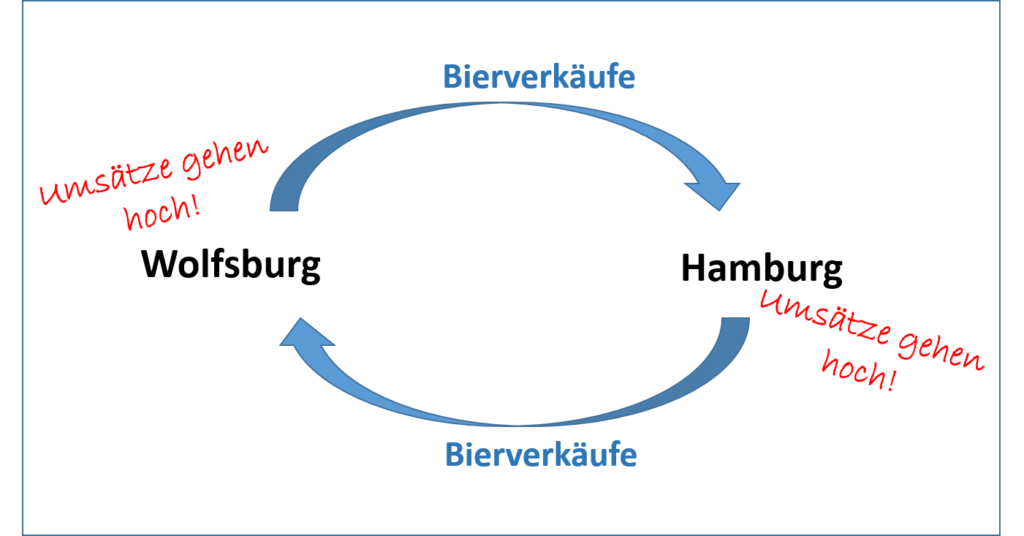
Original figure, explained in English
Beer sales run in both directions between Wolfsburg and Hamburg. Reported revenue rises on both sides.
Act Six: Bringing the Wolfsburg Pub into My Nuremberg Family
The auditor is not so easily satisfied. He now wants to know exactly what is happening at my Wolfsburg pub, which in reality sells no Burg-Bier at all. He wants to assess its performance. I explain that the Wolfsburg pub cannot really be considered in isolation. It is part of my large pub family, and a family must always be considered as a whole! So I simply combine the Wolfsburg pub’s figures with those of the Nuremberg pub. Crucially, the Nuremberg pub still makes a reasonable profit. Viewed together, their overall performance is far from excellent but still fairly respectable. That is enough for the auditor. Together, we clear his performance threshold. The investor is happy too. He buys another stake in my business at a still higher price.
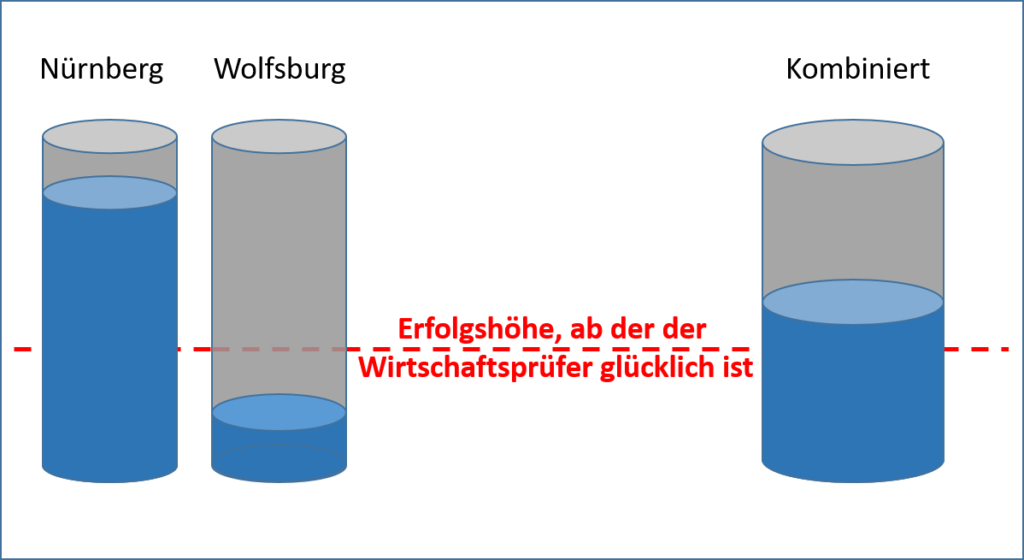
Original figure, explained in English
The columns show Nuremberg, Wolfsburg and the combined business. The red dashed line marks the performance level required to satisfy the auditor. Combining the two businesses brings the aggregate above that threshold.
Act Seven: Have I Gone Too Far?
Feeling rather pleased with myself, I plan my next steps. I make ‘loans’ to small pubs in Hamburg so that they can develop innovative and enjoyable new varieties of Burg-Bier. Of course, the pubs do not actually exist, but nobody knows that. All the money, neatly shared between my investor and me, goes straight into the pockets of my good friend in Hamburg. Naturally, he has promised to return most of it to me personally. Everything points to spectacular growth! My investor is so happy that he buys still more shares in my pub business at exorbitant prices. I am well on my way to becoming very rich.
Act Eight: The End
Admittedly, the story is becoming harder to sustain. Recently, Nuremberg’s beer regulator started asking awkward questions. Fortunately, it can only inspect my Nuremberg business and has no access to the Hamburg or Wolfsburg operations. What a relief! In Nuremberg, things still look reasonably healthy.
But there is another problem. A newspaper that has been publishing critical articles about my business for some time, and has probably been given some uncomfortable information about my conduct, persuades my investor to take a closer look at Hamburg and Wolfsburg. The investor hires a forensic investigator. As if that were not bad enough, I have also been unable to reach my good friend for a while. Where is he? I hope he is well and will soon pay me my share of our joint ‘deals’. He has not done so yet…
Disclaimer: This text is intended as a simplified introduction to the Wirecard case for non-experts. It is based solely on publicly available press reports. My personal assessments differ substantially in some respects, particularly regarding the roles of auditors and regulators. I use this text as a starting point in undergraduate teaching. We then discuss the actual circumstances and the problems with their portrayal in the press. The text also pays tribute to Paul Krugman’s article, Flavors of Fraud, published in The New York Times on 28 June 2002. It helped me enormously to understand the nature of accounting when I was a young doctoral student. Detailed analyses of the Wirecard case are available HERE, HERE, HERE, HERE and HERE.