

A few days ago, the IDW’s Expert Committee on Business Valuation and Business Administration (FAUB) addressed German auditors with recommendations on applying business valuation models during the coronavirus crisis (HERE). The main points of its statement are as follows:
- Uncertainty about companies’ future economic performance is currently very high and difficult to assess, as developments may change stochastically and intensify or diminish dynamically.
- Under the equivalence principle, uncertainty must be reflected in two places when applying valuation methods based on future financial benefits, such as discounted cash flow models: in expected future cash flows and, on an equivalent basis, in the risk premium investors require for bearing that uncertainty.
- Although the introduction suggests otherwise by linking the sharp global decline in share prices in spring 2020 to economic uncertainty, the statement presents recent stock market developments primarily as technical phenomena, including herding, liquidity needs and trading algorithms. It distinguishes these prices from fundamental valuations used for economic decisions, including capital measures, M&A transactions, impairment tests and expert valuations. Consequently, it argues that recent stock market developments should not be reflected in the risk premium used in business valuations. Short-term fluctuations and possible market overreactions are instead treated as indicators of current sentiment that need not persist over the long term.
These statements need to be put into context. Through the auditors they address, FAUB pronouncements typically affect a broad range of valuation assignments, from expert opinions and financial reporting to transaction advisory work.
Has Overall Uncertainty Increased?
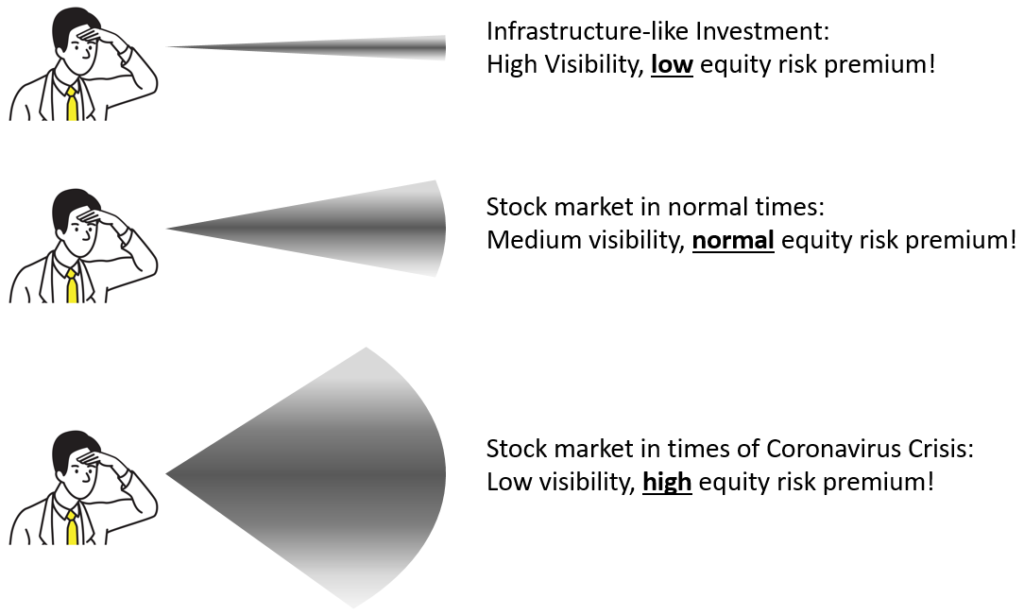
Let us start with the point on which there is probably little disagreement. In fundamental terms, ‘visibility’, meaning the predictability of future developments, has fallen dramatically in recent weeks. We simply lack reliable historical experience of comparable situations. For most business models, the coronavirus situation therefore bears some resemblance to valuing a start-up. We currently have no robust ‘base rate’ for our forecasts, no reasonably stable historical pattern that would narrow the distribution of possible future outcomes. How long will the coronavirus crisis last in Germany? At present, there is no sufficiently reliable answer, even if we follow the news every day. How long will it last in other countries to which the company being valued has exposure through its customers or supply chains? In most cases that is even harder to predict, because we have too little insight into those countries’ political processes. Politics also adds another layer of complexity: future developments during this crisis are shaped not only by business and market forces but particularly by political decisions. This makes forecasting harder for analysts and investors whose training is primarily in business and economics. Nor do the difficulties end with predicting the crisis’s duration. How much activity will subsequently be recovered? How will different national reopening dates shift market shares? What long-term structural changes will emerge? All these questions currently involve extreme forecasting uncertainty. Readers of the FAUB statement will recognise that its basic assessment of risk is not especially different from ours, even though it is expressed differently.
In two earlier articles on valuation and the coronavirus crisis, we attempted to offer guidance on improving forecasts in these conditions. The articles, both in English, are available HERE and HERE. Admittedly, they mainly address responses and conditional scenarios: how do companies and markets function when prolonged restrictions affect demand or supply? They say less about the base rate, namely how long the disruption will last and which specific areas of economic activity will be affected. The reason is simple: we know too little about that base rate.
Should Risk Be Reflected in Both the Numerator and the Denominator?
The next question is how uncertainty should be represented in a valuation model. Any increase in uncertainty must be clearly distinguished from changes in expected values. A valuer might still expect the same outcome on average, with no change in the expected value, while the range of possible outcomes widens substantially. Alternatively, the expected outcome might deteriorate while the range widens. For some business models, such as certain manufacturers of hygiene products, the expected outcome might improve while the range still widens. The particular combination of expected value and uncertainty should emerge from fundamental analysis. Whatever that analysis shows, however, the effects must be reflected separately in the expected value and in the risk measure.
In practice, present-value models usually reflect uncertainty about future developments by adjusting the discount rate. This is known as the risk-premium approach. The adjustment is necessary because investors are risk-averse: all else being equal, they prefer a certain outcome to a riskier one. Expected cash flows in the numerator are generally not adjusted for risk in practice. The different possible outcomes are simply combined into an expected value.
The FAUB’s explanation of how to account for risk is therefore imprecise at best. In a present-value model, the effect of uncertainty on value must be reflected EITHER in the denominator, through the risk-premium approach normally used in practice, OR in the numerator, through the certainty-equivalent approach, but not in both. This differs from inflation, for example, which must be treated consistently in both numerator and denominator. The method of accounting for risk also has nothing to do with the valuation equivalence principle, which concerns the relationship between the alternative investment and the company being valued. The FAUB statement gives the impression, to put it sharply, that calculating expected values properly is sufficient to capture increased risk: the additional uncertainty is reflected in forecast cash flows, while the equity risk premium remains unchanged. That impression is wrong.
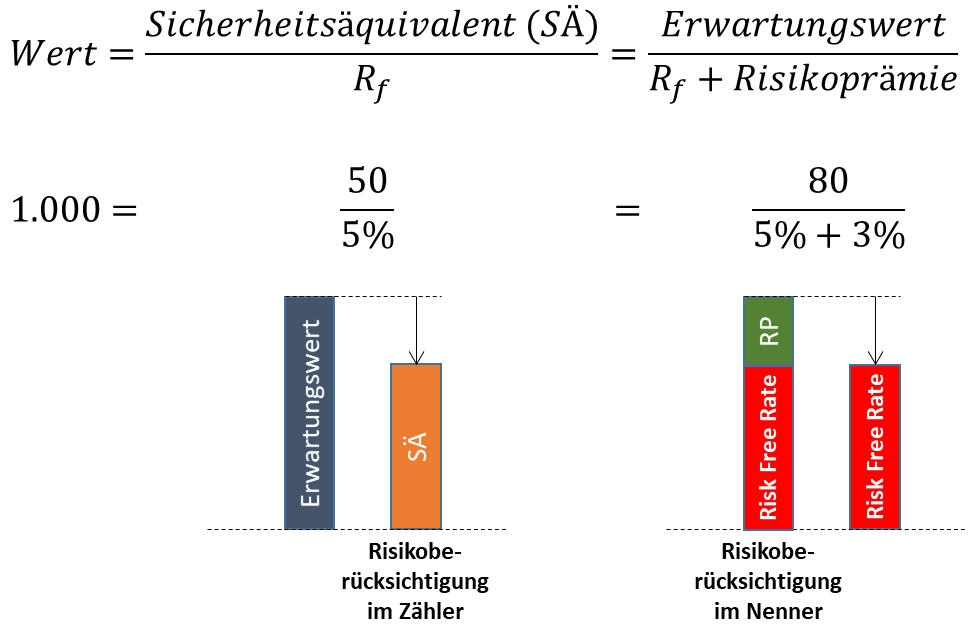
Original figure, explained in English
Value equals the certainty-equivalent cash flow divided by the risk-free rate, or the expected cash flow divided by the risk-free rate plus the risk premium. In the example: 1,000 = 50 / 5% = 80 / (5% + 3%).
On the left, the expected value is reduced to its certainty equivalent, labelled SÄ, so risk is reflected in the numerator. On the right, the risk premium, labelled RP, is added to the risk-free rate, so risk is reflected in the denominator.
We have described both approaches to clear up the misunderstanding, but the risk-premium approach remains the relevant method. There is no reason to depart from it. On the contrary, abandoning it in favour of a coronavirus-specific approach, perhaps using partial certainty equivalents, would be highly unusual, substantially increase the risk of double counting or omissions, invite subjective claims that risk has ‘already been included in the numerator’, and be impractical given the difficulty of specifying the risks created by coronavirus.
Greater Uncertainty, but No Higher Risk Premium?
This brings us to the claim that recent capital market developments and fundamental risk assessments are irrelevant to the equity risk premium. Non-fundamental effects have indeed been visible in stock markets in recent weeks. Investors’ liquidity needs have generally increased, partly because funding conditions have tightened since the crisis began. One indication is the recent sharp rise in the spread between LIBOR and overnight index swaps (OIS). The OIS rate represents the fixed leg of a swap against a floating overnight money market rate. A widening spread indicates a higher price for short-term credit risk and consequently tighter funding markets.
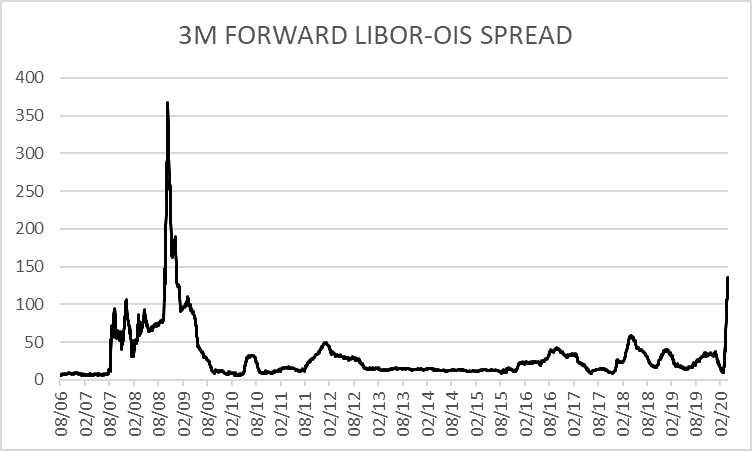
However, partly thanks to central bank measures, the LIBOR–OIS spread remains well below the levels reached during the 2008–09 financial crisis.
Net outflows from equity markets have also been observed. According to our information, global equity funds had experienced outflows of approximately USD 70 billion from the start of the crisis to the end of last week. That is roughly equivalent to the inflows over the preceding three months and, so far at least, is not particularly significant by historical standards. Some retail ETFs and hedge funds have seen substantial outflows, but overall these have not yet been extreme, particularly as some initial short covering is already evident. Investor redemption notices for hedge funds, as monitored by SS&C GlobeOp, had not increased by mid-March either.
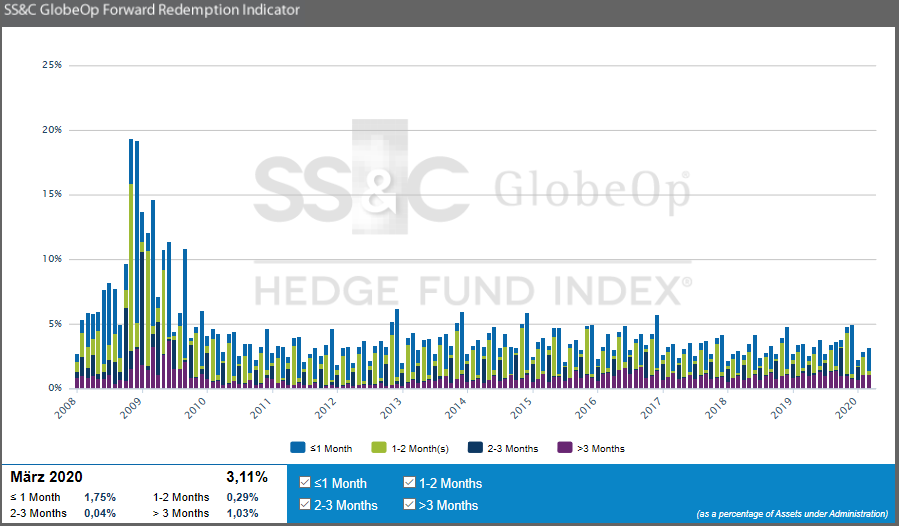
Source: http://www.globeopindex.com/forward_redemptions.go
Technical factors have therefore influenced stock market developments in recent weeks, but the figures suggest that their contribution has been limited.
The picture is different for indicators suggesting that an actual increase in equity market risk has been a major driver of recent movements. International volatility indices, which measure volatility implied by equity option prices, have risen sharply towards financial-crisis levels.
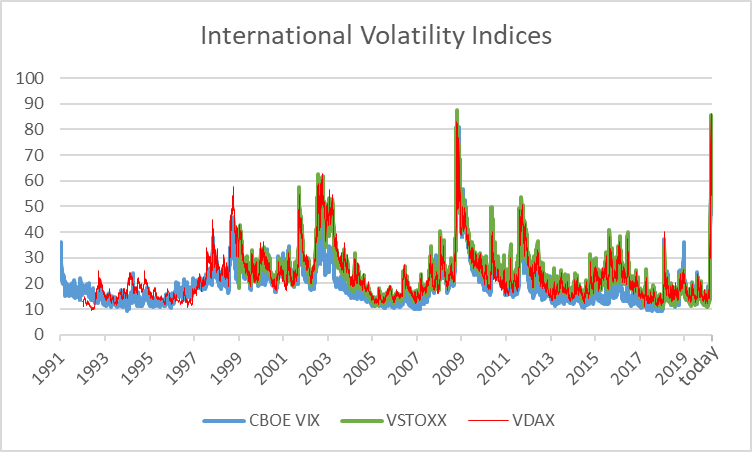
Rising volatility translates general uncertainty into a capital market risk parameter. Consider the market price of risk, meaning the premium investors require per unit of risk:

If this is assumed to remain even reasonably stable over time, which is a fairly sensible assumption, the rise in implied equity market volatility must have translated at least partly into a higher equity risk premium.
The consequence is clear. If uncertainty has increased, as can hardly be doubted at the market level at present, it MUST be reflected in the risk premiums used in present-value methods, provided the usual risk-premium approach is retained. This is fundamental to business valuation. It remains true even if the effects are assumed to be temporary.
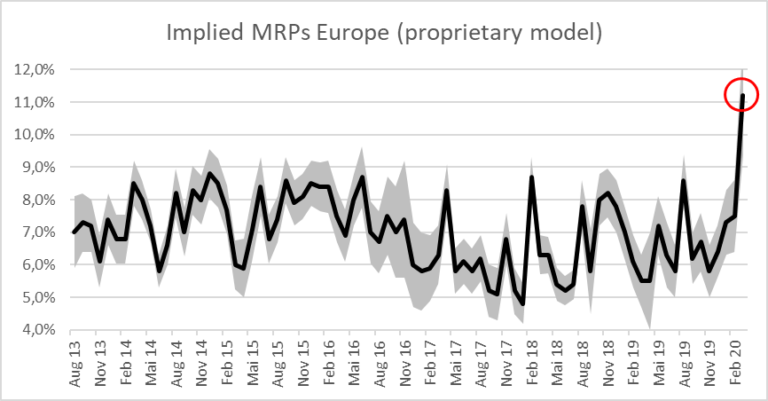
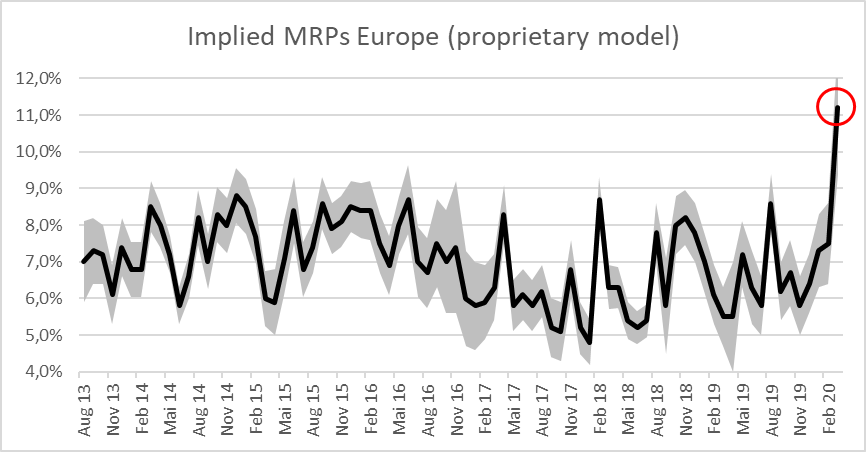
Our proprietary equity risk model shows the same development. Admittedly, we also make some subjective adjustments to address data problems, including technical stock market effects and the timeliness of analyst estimates. The model currently indicates an average equity risk premium of 11.2%, with the lower end of the range at approximately 10.2%.
Summary and Assessment
- Although the FAUB describes the risk environment largely appropriately, it draws surprising conclusions for business valuation. It refuses to infer consequences for decision-makers’ pricing of risk from stock market developments, distinguishing listed share prices from fundamentally derived values and treating short-term market fluctuations as sentiment indicators that need not persist. Indeed, by asserting that economic decisions are generally based on values derived from future financial benefits, it effectively places stock market prices outside the scope of economic valuation decisions altogether. Nor does it translate its own assessment of a substantially changed risk environment into a different risk premium. Its statement that there are no grounds for changing the methodology used to derive the capitalisation rate appears, in substance, to mean that the level of the market capitalisation rate should remain unchanged.
- The FAUB’s approach cannot be justified by treating the coronavirus crisis as a short, temporary and therefore apparently negligible episode in the life of a going concern. Even if the period of uncertainty were predictably short, which is by no means assured, and normal conditions were expected to return afterwards, uncertainty would extend beyond the duration of the episode itself. From a post-crisis perspective, equity risk premiums might again be close to historical averages. Today, however, we do not know AT WHAT LEVEL the new normal will emerge. Current uncertainty therefore affects the entire remaining forecast life of the company, normally extending into perpetuity. The valuer will know more once the episode is over, but that does not help at today’s valuation date. The implied equity risk premium from our proprietary model, like those from other available implied models such as Damodaran’s, therefore represents an average estimate of future equity risk premiums. It is an estimate for all future discounting periods, not merely for the next six months.
- This is precisely the wrong time for imprecise or incorrect valuation recommendations to auditors. First, a crisis generally demands far greater attention and technical judgement from valuers than a stable economic environment. Second, risk is central to the valuation challenges we currently face. Third, even without coronavirus, goodwill impairment testing under IFRS is already under such intense scrutiny that applying the tests properly is particularly important for strengthening auditors’ credibility.
- Analysing recent stock market developments, especially attributing their causes, is certainly not straightforward. Conclusions can only be drawn within ranges, and our analysis must sometimes rely on imperfect or even anecdotal information. Deriving implied equity risk premiums is also substantially model-dependent, which will not suit everyone. Our results should therefore always be treated with appropriate caution. We recognise that decision-making under uncertainty necessarily involves difficult judgements about the reliability of the conclusions available.
- Frankly, it is not the difference between our views and the FAUB’s that concerns us. People can analyse the same circumstances and reach different conclusions. It is the apparent ease with which the FAUB dismisses potentially important valuation effects under the guise of supposedly established capital market analysis and valuation theory. This is particularly disappointing because we generally value the FAUB and many of its members for the important discussions and publications that have advanced business valuation over the years.
- There may, of course, be reasons outside valuation theory for leaving risk premiums unchanged: maintaining stable valuation parameters while the crisis is still recent, or avoiding widespread impairments that could worsen some companies’ reported financial position. If so, however, the message should have been framed more appropriately or delivered by someone other than the FAUB.